UK Secure Storage Compliance Guide 2026
February 25, 2026
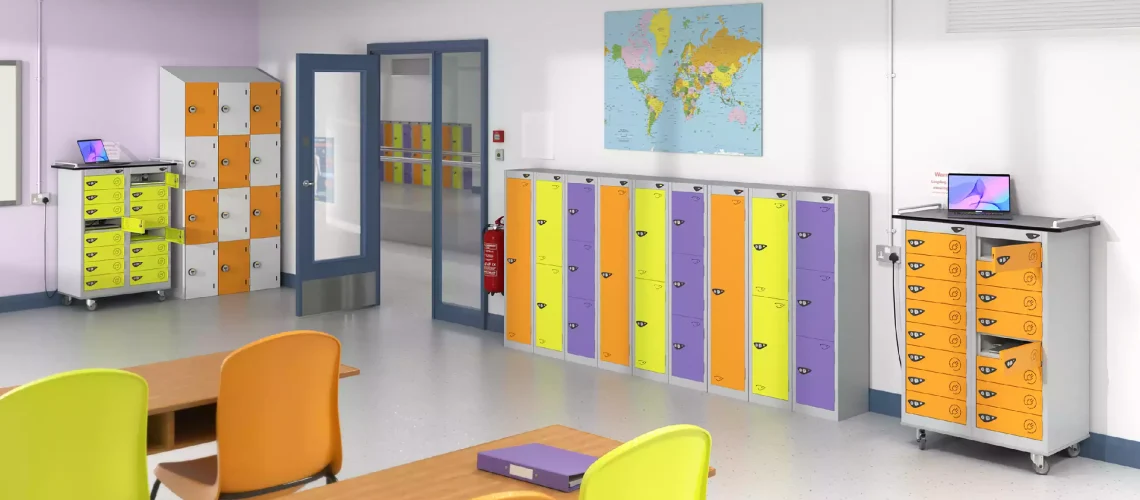
Secure storage compliance in the UK is not controlled by one universal locker, cabinet or safe regulation. The correct requirement depends on what is being stored, where it is used, who needs access, the risks involved and whether legislation, official guidance, British Standards, insurance conditions or local policy applies.
This guide provides a practical compliance map for lockers, medical cupboards, COSHH and flammable-liquid storage, school storage, gun safes, PPE storage, fire-resistant cabinets, key cabinets and general workplace storage. It is designed to help facilities managers, estates teams and procurement staff identify the correct specialist guidance before specifying a product.
Important: requirements differ between England, Wales, Scotland and Northern Ireland, and some guidance is sector-specific rather than law. Always confirm the rules that apply to your premises, contents and organisation before treating a product specification as compliant.

UK Secure Storage Compliance: Quick Answer
Start with the contents and risk, then identify the rules that actually apply. A medicine cupboard, flammable-liquid cabinet, fire-resistant document cabinet, gun cabinet and general steel storage cupboard may all look similar, but they are governed by very different requirements.
| Storage need | Main compliance route | Key point |
|---|---|---|
| Medicines | NHS/HBN guidance, medicines legislation, BS 2881 where applicable | Medicine type and setting determine the cabinet requirement |
| Controlled drugs | Safe-custody legislation plus healthcare/local procedures | Do not assume a general medical cabinet is suitable |
| Hazardous substances | COSHH risk assessment and substance-specific controls | COSHH does not prescribe one universal cabinet design |
| Flammable liquids | DSEAR and HSE fire/explosion guidance | Fire-resisting storage and spill control may be required |
| School lockers | Fire-risk assessment, building/estate safety and safeguarding procedures | No single statutory school-locker model exists |
| Firearms | Firearms certificate conditions and Home Office security guidance | Secure storage must prevent unauthorised access |
| PPE | PPE at Work Regulations and HSE guidance | Appropriate storage accommodation is a legal duty where PPE is provided |
| Fire-resistant documents/data | Relevant fire-test standards and insurer/site requirements | Paper and data media need different protection |
| Keys and access credentials | Risk-based security, data protection, safeguarding and internal controls | Audit trails are useful but not universally mandated |
| General workplace storage | Risk assessment, safe installation and manufacturer specification | BS 2881 is not a general industrial cabinet standard |
How Secure Storage Compliance Works in the UK
It helps to separate five different things that are often incorrectly described as “the regulations”.
- Acts and Regulations: legally enforceable duties such as COSHH, DSEAR, fire-safety law, firearms legislation and PPE regulations.
- Official guidance: documents from organisations such as HSE, Home Office, NHS England and government departments explaining how duties can be met.
- British and European Standards: technical specifications or test methods. A standard is not automatically a legal requirement simply because it exists.
- Insurance and contractual conditions: an insurer, client, framework or procurement specification can require a particular security or fire rating.
- Manufacturer requirements: fixing, loading, environmental and operating instructions that affect safe installation and use.
A good procurement decision identifies which of these layers applies before selecting a cabinet. This avoids two common errors: specifying a standard that is irrelevant to the contents, or calling a product “compliant” without knowing what requirement it is meant to comply with.
Healthcare, NHS and Medical Storage Compliance
Healthcare storage should not be reduced to a single statement that “NHS lockers must comply with HTM 63 or HTM 71”. Those documents relate to fitted storage systems and materials-management modular storage. They are useful healthcare-estates references, but they are not blanket statutory standards for every staff locker or medical cupboard.
For medicines storage in clinical areas, NHS England’s current Health Building Note 14-02 is more directly relevant. It provides best-practice guidance for medicines, including controlled drugs, and states that metal medicines cupboards should be provided to ensure compliance with BS 2881 in the applications covered by the HBN.
BS 2881:1989 is specifically the British Standard for cupboards used to store medicines at ambient temperature in healthcare premises. It is not a general strength or durability standard for industrial steel cabinets.
Controlled drugs need separate attention. A general medicine cabinet, first-aid cabinet or lockable internal compartment should not automatically be treated as satisfying controlled-drug safe-custody requirements.
For detailed procurement decisions, use our medical storage compliance guide and controlled drug cabinet requirements guide. For suitable general medical storage products, see the KFAK medical cabinet range.
COSHH Cabinets and Hazardous-Substance Storage
The Control of Substances Hazardous to Health Regulations 2002 require employers to assess and control exposure to substances hazardous to health. COSHH does not state that every hazardous chemical must be stored in one specific type or colour of cabinet.
Storage should follow the risk assessment, the substance properties, the safety data sheet and any relevant HSE guidance. Different substances may need segregation because mixing incompatible chemicals can create additional risks.
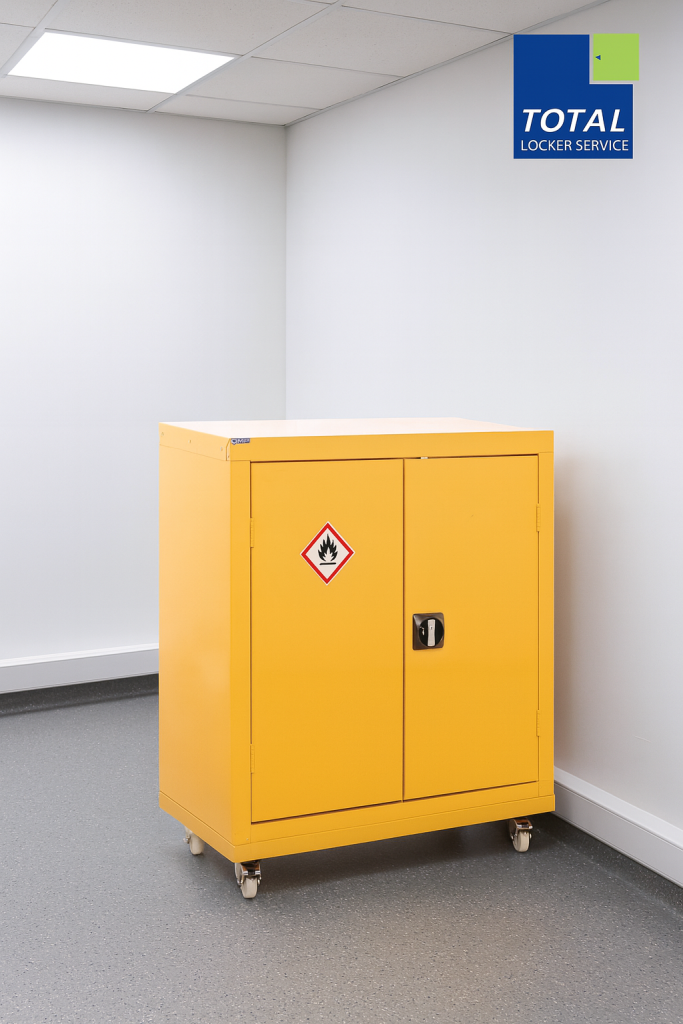
Flammable liquids need DSEAR consideration
Where the hazard is fire or explosion from a dangerous substance, the Dangerous Substances and Explosive Atmospheres Regulations 2002 (DSEAR) are particularly important. HSE guidance says limited quantities of flammable liquids needed in workrooms should be kept in suitable fire-resisting cupboards or bins when not in use, with design intended to delay fire involvement and retain spills.
HSE also makes clear that enhanced standards such as BS EN 14470-1 may exceed the minimum construction requirements and are not automatically a legal requirement in every UK workplace. The dutyholder still has to justify the storage arrangements through the risk assessment.
Use our COSHH cabinet legal requirements UK guide for the detailed distinction between COSHH, DSEAR, flammables and general chemical storage.
School and Education Locker Compliance
There is no single UK law prescribing one approved school-locker construction. Schools need to consider the fire-risk assessment, safe escape routes, installation stability, safeguarding, accessibility, durability and the suitability of the locker for its location.
For educational premises in England, the government fire-safety risk-assessment guidance is the starting point for existing buildings. It specifically recognises that non-combustible lockers may be acceptable in some circulation or escape-route situations where the risk assessment supports them and minimum exit widths are maintained.
This means it is inaccurate to state that all school lockers must carry a particular BS EN 13501 reaction-to-fire classification. Material fire performance may matter to a project specification, but the school’s overall fire strategy and risk assessment determine what is acceptable in the actual location.
- Do not reduce required escape widths.
- Do not create an unacceptable fire load or obstruction in escape routes.
- Secure lockers where tipping, movement or misuse creates a foreseeable risk.
- Choose locks and master-access procedures that fit the school’s safeguarding policy.
- Use materials and finishes appropriate to wet, changing-room or hygiene-sensitive locations.
For the specialist article, see school locker safety requirements UK. You can also compare plastic lockers for wet and moisture-prone environments.
Gun Safe and Firearm Storage Compliance
Firearms certificate conditions require firearms and shotguns to be stored securely so that, so far as reasonably practicable, unauthorised people cannot gain access. The current Home Office Firearms Security Handbook provides detailed guidance on cabinets, safes, fixing and location.
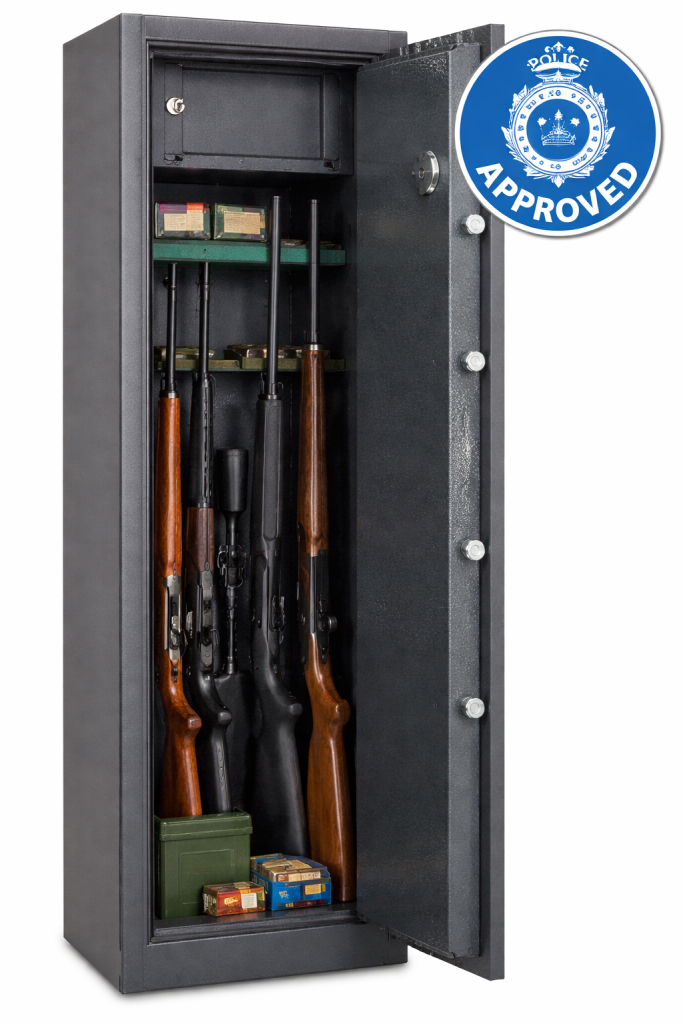
The Home Office guidance says that new purpose-designed gun cabinets should conform to BS 7558:1992. It also says the cabinet should be fixed to the structure and positioned to make attack or identification by casual visitors more difficult. Section 1 ammunition must also be kept secure.
Avoid treating “police approved” as a universal certification mark. Final suitability depends on the cabinet, firearms, premises, installation and the requirements applied by the relevant firearms licensing authority.
See our gun safes, shotgun cabinets and rifle safes for products where BS 7558 compliance is stated in the individual specification.
PPE Storage Requirements
PPE storage has a clearer statutory basis than many general locker applications. The Personal Protective Equipment at Work Regulations 1992, as amended in 2022, require appropriate accommodation for PPE when it is not being used.
HSE guidance explains that storage should help prevent damage from chemicals, sunlight, humidity, heat and impacts; prevent contamination; reduce loss; and, where needed, allow PPE to dry sufficiently. The correct storage may be a locker or cupboard, but it can also be another suitable form of accommodation depending on the PPE.
Where PPE becomes contaminated, clean and ready-to-use equipment should be managed so that contamination is not transferred through the storage area.
Use our PPE storage requirements UK guide for a more detailed workplace checklist.
General Workplace and Industrial Cabinet Requirements
There is no single British Standard called “BS 2881 steel storage cabinet standard” for general commercial and industrial cupboards. BS 2881 is a medicines-cupboard standard.
For ordinary workplace cabinets, specification should instead follow the actual use and foreseeable risks. Check construction, stability, shelf loading, lock suitability, fixing requirements, environment, access and the manufacturer’s instructions. Where a tender or customer requires a particular furniture performance standard, confirm that exact standard with the supplier rather than assuming it applies to every steel cabinet.
- Confirm shelf and cabinet load capacities.
- Assess tipping or movement risk when doors or drawers are open.
- Use suitable wall or floor fixing where the risk assessment or manufacturer requires it.
- Choose corrosion-resistant materials for wet or aggressive environments.
- Do not use a general cabinet for medicines, flammables, firearms or fire-protected records unless it is specifically suitable for that purpose.
For general storage options, compare our steel storage cabinets.
Fire-Resistant Cabinets, Safes and Insurance Ratings
Fire protection and burglary resistance are separate characteristics. The original version of this guide incorrectly listed BS EN 14450 and EN 1143-1 as fire certifications. They are security/burglary-resistance standards, not document fire-resistance standards.
| Standard | Main purpose |
|---|---|
| BS EN 15659 | Light fire storage units for paper documents |
| BS EN 1047-1 | Fire-resisting data cabinets and data inserts |
| BS EN 14450 | Burglary resistance of secure cabinets |
| EN 1143-1 | Burglary resistance of safes, strongrooms and related secure storage |
If insurance acceptance matters, obtain the insurer’s required fire or security classification before purchase. Do not assume that a product described simply as “fireproof” or “insurance rated” satisfies every policy.
Use our dedicated fire-rated cabinet requirements UK guide for the standards detail, or browse fireproof safes and fire-resistant cabinets.
Key Cabinets and Access-Control Compliance
There is no universal UK law requiring every organisation to use a key cabinet or electronic key-management system. The requirement is normally risk-based and can arise from safeguarding, physical security, medicines control, data protection, fleet management, insurer requirements or internal audit procedures.
Where keys give access to sensitive areas or assets, the system should make it clear who is authorised, how spare and master keys are controlled, and how access is removed when roles change. An electronic audit trail may be valuable in higher-control environments, but it is not automatically required for every workplace.
See our key control cabinet requirements guide or browse key cabinets.
Secure Physical Storage and UK Data Protection
UK data-protection law does not prescribe a particular filing cabinet, locker or safe. It requires organisations to use appropriate technical and organisational measures to protect personal data against risks including unauthorised access, loss, destruction and damage.
The ICO explicitly treats physical security as part of information security. For paper records or removable media, an appropriate control may include restricted rooms, suitable locks, secure cabinets, access procedures, disposal controls or other measures proportionate to the risk.
This means “GDPR compliant cabinet” is usually an over-simplification. Compliance comes from the whole security system: access control, policies, physical protection, staff procedures, retention and disposal, not from a cabinet label by itself.
UK Secure Storage Procurement Checklist
- 1. Identify the contents: personal belongings, medicines, controlled drugs, chemicals, flammables, PPE, documents, data media, keys, firearms or valuables.
- 2. Identify the hazard: theft, unauthorised access, fire, contamination, chemical exposure, fire/explosion, data loss or physical injury.
- 3. Check the legal jurisdiction: confirm which UK nation and sector rules apply.
- 4. Separate law from guidance: identify whether the requirement comes from legislation, official guidance, a British Standard, insurer or contract.
- 5. Check the exact standard: confirm the standard number, edition, classification and what it actually tests.
- 6. Confirm the product evidence: request certificates or manufacturer data where a rating is required.
- 7. Check capacity and load: use internal dimensions and stated shelf or cabinet load limits.
- 8. Plan installation: assess fixing surface, floor loading, escape routes, door opening and delivery access.
- 9. Plan access control: decide who holds keys, codes or override credentials and how access changes are managed.
- 10. Keep evidence: retain risk assessments, specifications, certificates, installation information and relevant policy records.
Common Secure Storage Compliance Errors
- Calling every British Standard mandatory. Standards can be required by law, guidance, contract or insurer, but many are voluntary technical standards unless specifically incorporated into a requirement.
- Using BS 2881 for industrial cabinets. BS 2881 is for medicines cupboards in healthcare premises.
- Using BS EN 14450 as a fire rating. It is a burglary-resistance standard.
- Treating all hazardous substances as flammable liquids. COSHH and DSEAR address different risks and may both need consideration.
- Calling a gun cabinet “police approved” without qualification. Final suitability depends on the installation, premises and firearms licensing assessment.
- Calling a cabinet “GDPR compliant”. Data protection requires a risk-appropriate security system, not a universal cabinet certification.
- Ignoring installation. A suitable cabinet can still create a compliance or safety problem if it blocks an escape route, is unstable or is fixed to an unsuitable structure.
UK Secure Storage Compliance FAQs
Is there one UK law covering all secure storage cabinets?
No. Requirements depend on the contents, sector, premises and risk. Medicines, hazardous substances, flammable liquids, firearms, PPE, fire-resistant records and general workplace storage are governed by different legal and technical frameworks.
Are British Standards legally mandatory?
Not automatically. A British Standard may become a practical requirement through legislation, official guidance, a contract, procurement specification, insurer condition or sector policy. Always identify why the standard applies before specifying it.
What does BS 2881 cover?
BS 2881:1989 specifies cupboards for storing medicines at ambient temperature in healthcare premises. It is not a general industrial steel-cabinet strength standard.
Does COSHH require a yellow chemical cabinet?
COSHH requires employers to assess and control exposure to hazardous substances but does not prescribe one universal cabinet colour or design. Storage should follow the risk assessment, substance properties, safety data sheet and any other relevant requirements such as DSEAR for flammable dangerous substances.
Do school lockers need a specific British Standard?
There is no single statutory British Standard that every school locker must meet. Schools should consider fire-risk assessment, escape routes, installation stability, accessibility, safeguarding, durability and any project-specific material requirements.
Does UK law require storage for workplace PPE?
Yes, where PPE is required under the Personal Protective Equipment at Work Regulations, appropriate accommodation must be provided for it when it is not in use. The form of storage depends on the PPE and the risks it needs protection from.
Is BS EN 14450 a fire-safe standard?
No. BS EN 14450 is a burglary-resistance standard for secure cabinets. Fire protection should be evidenced by a separate fire-test standard or classification suitable for the contents.
Specialist UK Compliance Guides
- Medical Storage Compliance UK
- Controlled Drug Cabinet Requirements UK
- COSHH Cabinet Legal Requirements UK
- School Locker Safety Requirements UK
- PPE Storage Requirements UK
- Fire-Rated Cabinet Requirements UK
- Key Control Cabinet Requirements UK
- Locker Installation Regulations UK
Final Thoughts
Secure storage compliance is strongest when the specification begins with the legal and operational risk rather than with a cabinet label. The words “secure”, “fire rated”, “medical”, “COSHH”, “insurance rated” or “compliant” only become meaningful when they are tied to a specific requirement and evidence.
Identify the contents, applicable jurisdiction, legislation, official guidance, technical standard, insurer or contractual requirement, then select and install the storage product to match. Use the specialist guides above when a sector has its own detailed rules rather than relying on one broad compliance article for every storage type.
Discover more from Blog Total Locker Service
Subscribe to get the latest posts sent to your email.