How to Choose Workplace Lockers for a New Office Fit-Out
April 1, 2026
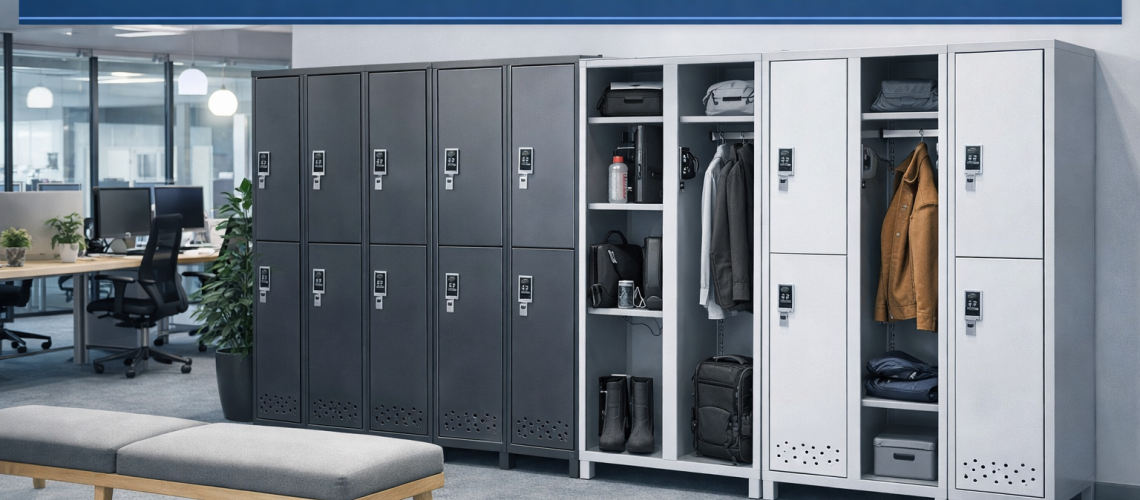
Workplace lockers are an important part of many modern office fit-outs, particularly where staff use hybrid working, shared desks, hot-desking or flexible attendance. A successful office locker scheme provides enough space for coats, laptop bags, personal belongings and daily essentials while using the available floor area efficiently.
Choosing office lockers is therefore not simply a question of selecting a product style or fitting the maximum possible number of compartments along a wall. The project should consider staff attendance, peak occupancy, what people actually bring to work, assigned or shared use, locker size, location, access method, future growth and how the storage fits into the wider office.
This guide brings those decisions together for new office fit-outs, refurbishments, hybrid workplaces, agile offices, hot-desking environments and staff storage areas.
For the broader workplace subject, see our Workplace Lockers UK guide. For operational allocation, access and administration across a locker estate, use the Locker Management Systems UK guide.
Quick Answer: How Should You Plan Lockers for a New Office?
Start with how many people are realistically likely to need storage at the same time, not simply the total number of employees on the payroll.
Then establish:
- what staff need to store;
- which days have the highest attendance;
- whether particular teams attend together;
- whether lockers will be assigned, shared, day-use or a mixture;
- whether visitors and contractors need storage;
- where the lockers should sit within the staff journey;
- what access method is appropriate;
- whether device charging is required;
- and how much spare capacity should be allowed for growth.
Plan the locker requirement around peak workplace use and real staff behaviour, then choose the locker size, quantity and technology.
Why Lockers Matter in a Modern Office Fit-Out
Modern offices increasingly separate personal storage from the desk. Employees may move between shared workstations, meeting rooms, collaboration spaces and quiet areas rather than working from one permanently assigned position.
Suitable locker storage can help:
- keep bags and coats away from desks;
- support hot-desking and shared workstations;
- provide secure personal storage;
- support hybrid attendance;
- reduce clutter around working areas;
- provide storage for laptops and accessories;
- create a clear arrival and personal-storage zone;
- and reduce reliance on informal storage around the office.
The locker bank should therefore be considered during the office-planning stage rather than added after the main furniture layout has already been fixed.
Step 1: Understand How the Office Actually Works
The office operating model should be established before deciding locker quantity.
- Do employees have permanently assigned desks?
- Is the office partly or fully hot-desked?
- How many days per week do employees normally attend?
- Which weekdays are busiest?
- Do teams attend together?
- Are different departments based on different floors?
- Do employees leave belongings overnight?
- Do staff transport laptops between home and office?
- Are visitors and contractors provided with storage?
- Is future workforce growth expected?
A traditional office with regular attendance may favour assigned lockers. A hybrid office with changing attendance may benefit from shared or day-use storage. Some workplaces work best with a mixture of both.
Step 2: Plan Around Peak Attendance, Not Average Attendance
Average office occupancy can be misleading. A hybrid office may be relatively quiet on some days but substantially busier when several teams attend together.
Locker capacity should therefore be tested against the busiest realistic attendance pattern.
- peak office days;
- department attendance patterns;
- team days;
- training days;
- company meetings and events;
- visitor demand;
- contractor demand;
- temporary workers;
- and planned workforce growth.
An office with 200 employees does not automatically need 200 day-use lockers. Equally, providing only enough storage for a low daily average may create regular shortages when several teams attend together.
For a detailed workplace calculation, see How Many Workplace Lockers Do You Need?
Look at Department and Team Attendance Patterns
Whole-building attendance figures can hide local pressure. An office may have spare locker capacity overall while a particular floor or department regularly runs short because most of that team attends on the same days.
Where possible, review demand by:
- team;
- department;
- floor;
- work zone;
- shift;
- and normal arrival period.
This can help determine whether one central locker bank, several smaller storage zones or a combination will work best.
Step 3: Decide What Employees Need to Store
Locker size should follow the contents. Staff may bring considerably more into the office than is initially assumed.
| Typical item | Why it matters |
|---|---|
| Laptop bag or backpack | Often establishes the practical minimum compartment width and depth |
| Coat or jacket | Requires a deliberate decision about hanging, folding or separate coat storage |
| Handbag | Needs usable internal volume rather than nominal dimensions alone |
| Laptop and charger | May require secure storage and sufficient depth |
| Lunch bag | Can consume significant space alongside a work bag |
| Headphones and accessories | Add to everyday storage volume |
| Shoes or trainers | Common for commuters or staff using shower facilities |
| Gym or cycling items | May justify larger storage for some users |
A compartment that is technically large enough for one item may still be frustrating when several everyday belongings need to be stored together.
Laptop Bags Often Establish the Practical Minimum Size
Hybrid employees commonly transport laptops, chargers, notebooks, headsets and other equipment between home and office in one backpack or work bag.
If that bag cannot fit comfortably inside the locker, users may leave it around desks even if the laptop itself fits.
Where possible, test a proposed compartment using the types of bags employees actually carry.
Decide Explicitly Where Coats Will Go
An office can use several approaches:
- full-height lockers with hanging space;
- larger personal compartments;
- separate coat cupboards;
- cloakroom storage;
- or a combination of compact lockers and separate coat storage.
If employees are expected to put coats in their lockers, the compartment needs enough usable volume to accommodate them.
Step 4: Choose Between Assigned, Shared, Day-Use and Hot Lockers
Assigned Lockers
An assigned locker remains associated with the same employee. This can suit staff who attend regularly, need dependable personal storage or retain approved belongings at work.
Shared Day-Use Lockers
Shared lockers are used by different employees on different days. They can reduce the amount of permanently allocated storage where attendance varies.
Hot Lockers
A hot locker is selected from an available pool when the employee attends rather than being permanently assigned in advance. It applies a similar principle to hot-desking: storage is available when required but is not permanently reserved for one person.
Hot lockers can work well in agile and hybrid environments, but they depend on sufficient availability and clear release procedures.
For a detailed comparison, see Assigned vs Shared Staff Lockers for Hybrid Workplaces.
Shared Lockers Do Not Automatically Need Smaller Compartments
A hybrid employee using a locker for one day may still arrive with a coat, laptop backpack, chargers, lunch, headphones and other commuting items.
Sharing changes who uses the compartment, not necessarily what needs to fit inside it.
A Mixed Locker Model Can Work Well
Many hybrid workplaces do not need to choose one allocation model for everybody. A mixed system can provide assigned lockers for employees who require permanent storage while using shared or day-use compartments for employees with more flexible attendance.
| User group | Possible storage model |
|---|---|
| Regular office-based staff | Assigned locker |
| Hybrid employees | Shared or day-use locker |
| Field-based employees | Shared storage with some larger compartments |
| Visitors | Temporary-use locker |
| Contractors | Temporary or controlled assigned storage |
| Employees with specialist equipment | Assigned or larger compartment |
This often provides a better balance between staff convenience and efficient use of office space than forcing every user into the same arrangement.
Step 5: Include Visitors, Contractors and Temporary Users
Locker planning sometimes considers permanent employees but overlooks other people who regularly use the building.
Temporary demand can include:
- visitors;
- contractors;
- agency staff;
- consultants;
- training delegates;
- project teams;
- and employees visiting from other company locations.
These users may need separate temporary lockers or access to a controlled part of the shared locker pool. Visitor lockers often work better near reception or another controlled arrival point rather than deep within employee-only areas.
Step 6: Allow Sensible Reserve Capacity
A locker scheme planned exactly to today’s maximum requirement can become restrictive very quickly.
A practical allowance may be needed for:
- new employees;
- department growth;
- temporary users;
- damaged lockers awaiting repair;
- changes in hybrid-working policy;
- and occasional attendance peaks.
The reserve should be proportionate. The objective is not to install large amounts of unused storage, but to avoid creating a system with no flexibility.
Step 7: Choose a Suitable Locker Configuration
| Configuration | Can suit | Main consideration |
|---|---|---|
| Single-door or full-height | Coats, larger bags and hanging storage | Good volume but fewer users per column |
| Two-tier | Bags, clothing and medium personal storage | Useful balance of volume and capacity |
| Three or four-tier | Laptop bags and daily belongings | Check actual internal dimensions |
| Multi-door personal storage | Smaller daily items | Do not sacrifice usability simply to increase door count |
| Mixed configuration | Workforces with varied requirements | Can provide flexibility without oversizing every compartment |
A Mix of Locker Sizes Can Improve Space Efficiency
Most employees may need a standard day-use compartment while a smaller proportion need additional capacity for clothing, cycling equipment or other belongings.
In this situation, a principal bank of standard lockers combined with a smaller number of larger compartments can sometimes use space more efficiently than making every compartment large enough for the most demanding user.
Step 8: Position Lockers Around the Staff Journey
Locker position should follow the way employees arrive, work and leave.
Common locations include:
- just beyond reception;
- along the staff arrival route;
- at the edge of the open-plan office;
- at the edge of a hot-desking zone;
- within a dedicated personal-storage area;
- or within a separate locker room.
For many offices, the ideal sequence is:
Arrival → personal storage → working area
For a detailed placement comparison, see Should Staff Lockers Be in Open Plan Areas or Separate Storage Zones?
Hot-Desking Lockers: Close, but Not Necessarily Inside the Desk Core
Hot-desking storage should be convenient, but locker doors, bags and people standing immediately beside occupied desks can create unnecessary activity.
An edge-of-zone position can provide a useful balance:
- staff reach the storage easily;
- personal belongings are removed before settling at a desk;
- locker activity remains outside the densest working area;
- and employees can still return to the locker during the day.
Consider Device Charging and Technology Storage
Some office environments need lockers for laptops, tablets, phones or other devices as well as personal belongings.
Where charging is required, planning should consider:
- what devices are being stored;
- how often staff need to retrieve them;
- the required compartment size;
- electrical provision;
- ventilation where relevant to the product;
- the position of the locker bank;
- and access for inspection and maintenance.
Charging lockers accessed repeatedly during the day may justify a position somewhat closer to the active work zone than lockers used only for coats and bags.
See our charging lockers and device storage.
Step 9: Choose the Locker Access Method
| Lock type | Can suit | Main management consideration |
|---|---|---|
| Key lock | Assigned office lockers | Key issue and replacement |
| Padlock fitting | Simple user-managed storage | Lost and abandoned padlocks |
| Mechanical combination | Assigned or suitable shared storage | Forgotten codes and reset procedure |
| Electronic PIN lock | Flexible or shared storage | Administration, reset and override |
| RFID | Managed offices with compatible staff credentials | Credential issue and revocation |
| Smart locker system | Large or high-turnover flexible workplaces | Software, administration and operational support |
Technology should solve a genuine management requirement rather than being added simply because it is available.
For workplace lock selection, use Best Lock Options for Workplace Lockers. For products, visit our locker locks range.
When Do Smart Office Lockers Make Sense?
Smart locker systems can be useful where a workplace needs dynamic allocation, digital credentials, occupancy information, audit records or centralised administration. They are particularly relevant where a large shared locker estate needs to support changing users.
Potential functions include:
- temporary locker assignment;
- RFID, card or mobile access;
- automatic release;
- live availability;
- usage records;
- remote administration;
- user permissions;
- maintenance alerts.
Smart technology is not automatically necessary for a hybrid office. If the locker population is small and staff behaviour is straightforward, a mechanical combination or stand-alone electronic lock may provide the required flexibility with less infrastructure and administration.
Step 10: Define How Shared Lockers Will Be Managed
Shared lockers require a clear operating process. It should not be left to staff to decide informally whether lockers may be retained overnight or indefinitely.
Decide:
- how a user obtains a locker;
- whether lockers are first-come, allocated or bookable;
- whether overnight storage is allowed;
- when the locker should be released;
- how abandoned belongings are handled;
- how forgotten codes or credentials are reset;
- who has authorised override access;
- how faults are reported.
For detailed shared-use operation, see Day-Use Office Lockers for Hybrid Workplaces.
Step 11: Measure Whether the Locker Plan Is Working
Locker planning should not necessarily end when the fit-out is complete.
After occupation, facilities teams can review:
- which locker banks are heavily used;
- which areas are underused;
- which days reach peak demand;
- whether assigned lockers remain inactive;
- whether shared lockers turn over correctly;
- whether users struggle to find available storage;
- whether the planned reserve capacity is adequate;
- and whether particular departments need additional provision.
This does not require every office to install a smart system. Smaller workplaces can use periodic physical reviews and allocation records. Larger shared locker estates may benefit from digital reporting.
For detailed utilisation, availability and turnover, see the Locker Occupancy Management Systems UK guide.
Locker Planning and Office Space Rationalisation
Locker planning can form part of a wider review of how office space is used.
Hybrid workplaces may reduce permanently assigned desks while creating more:
- shared workstations;
- collaboration areas;
- meeting spaces;
- touchdown desks;
- quiet areas;
- and shared staff facilities.
Personal storage still needs to be provided somewhere. Well-planned lockers can support flexible desk use without requiring every individual to retain a permanently assigned workstation and storage position.
The aim should not simply be to reduce locker numbers. It should be to match the storage estate to the way the building is actually used.
Facilities Data Can Improve Future Locker Decisions
Larger managed locker systems may provide information such as:
- live availability;
- daily utilisation;
- peak demand;
- usage duration;
- underused locker banks;
- shared-locker turnover;
- and maintenance alerts.
This information can help facilities managers decide whether storage should be expanded, reduced, relocated or reallocated.
Detailed operational analytics belong in the occupancy management guide rather than being duplicated here.
Step 12: Allow for Future Workplace Change
Office attendance and staffing patterns can change quickly. A fit-out designed around one exact snapshot can become restrictive if the business grows or working policy changes.
- Allow reasonable reserve capacity.
- Consider whether shared storage could later become assigned.
- Consider whether assigned storage could become shared.
- Allow for departments moving between floors.
- Keep scope for an additional locker bank where practical.
- Choose locks and components that can be maintained.
- Review occupancy after major workplace changes.
Step 13: Match the Locker Finish to the Office
Office lockers are often much more visible than lockers in warehouses or back-of-house changing rooms.
Once the functional requirement has been established, compare materials based on:
- appearance;
- durability;
- daily traffic;
- cleaning requirements;
- budget;
- and the surrounding interior.
For a detailed comparison, see Best Materials for Office Lockers: Steel, Laminate or MFC?
Step 14: Check the Locker Bank Against the Physical Layout
Do not approve locker capacity using wall length alone.
- Check locker depth.
- Allow locker doors to open.
- Allow users to stand in front of the lockers.
- Keep circulation routes usable.
- Avoid busy locker banks immediately beside narrow entrances.
- Consider nearby desks and seating.
- Check the ends of locker runs and corners.
- Keep services and maintenance points accessible.
- Allow cleaning access.
For detailed workplace dimensions, positioning, staff flow and shift planning, use the Workplace Locker Layout Guide UK.
Different User Groups May Need Different Storage
| User group | Possible requirement |
|---|---|
| Hybrid office staff | Laptop bag, coat and daily belongings |
| Permanent office staff | Potentially assigned personal storage |
| Field-based employees | Larger bags or equipment when visiting the office |
| Cyclists | Additional clothing, footwear, helmet or accessories |
| Visitors | Temporary storage for bags and coats |
| Contractors | Temporary personal or equipment storage |
Common Office Locker Planning Mistakes
- Installing one locker per employee without reviewing attendance.
- Planning from average attendance rather than realistic peak demand.
- Ignoring department and team attendance patterns.
- Forgetting visitors and contractors.
- Making compartments too small for laptop bags.
- Failing to decide where coats will be stored.
- Assuming shared lockers should automatically be smaller.
- Providing no reserve capacity for future growth.
- Maximising compartment count rather than useful storage.
- Positioning lockers wherever spare wall space remains.
- Putting hot-desk lockers directly inside the densest desk area.
- Installing shared lockers without clear release rules.
- Adding smart technology without a genuine operational need.
- Failing to review locker utilisation after occupation.
- Treating locker planning as separate from wider office-space planning.
Step-by-Step Workplace Locker Fit-Out Process
- Define how the office operates.
- Record total staff numbers.
- Identify realistic peak attendance.
- Review team and department attendance patterns.
- Include visitors, contractors and temporary users.
- List what employees actually bring to work.
- Measure typical laptop bags and backpacks.
- Decide where coats will be stored.
- Choose assigned, shared, hot or mixed allocation.
- Calculate required locker capacity.
- Allow sensible reserve capacity.
- Choose the compartment size.
- Consider whether mixed locker sizes would help.
- Choose the locker configuration.
- Map the employee arrival-to-desk journey.
- Choose the locker-bank location.
- Check depth, door opening and circulation.
- Consider charging requirements.
- Choose the lock or access method.
- Define how shared lockers will be released.
- Choose materials and finishes.
- Allow maintenance and cleaning access.
- Review utilisation once the office is occupied.
- Adapt the system as attendance and staffing change.
Office Locker Fit-Out Checklist
- What is the total employee population?
- What is the busiest realistic attendance?
- Which days are busiest?
- Do particular teams attend together?
- Are lockers assigned, shared, day-use or hot?
- What do employees actually store?
- Do laptop bags fit comfortably?
- Where are coats stored?
- Do visitors need lockers?
- Do contractors need lockers?
- Is future workforce growth allowed for?
- Would mixed locker sizes improve the scheme?
- Where will lockers be positioned?
- Do staff naturally pass the locker bank?
- Are the lockers too close to working desks?
- Can doors open comfortably?
- Is charging required?
- What access method will be used?
- How will temporary lockers be released?
- How will abandoned belongings be managed?
- Can occupancy be reviewed after installation?
- Can the system adapt to future workplace changes?
Related Workplace Locker Guides
- Workplace Lockers UK: Staff Storage, Security, Compliance and Layout Guide
- Workplace Locker Layout Guide UK
- How Many Workplace Lockers Do You Need?
- Assigned vs Shared Staff Lockers for Hybrid Workplaces
- Day-Use Office Lockers for Hybrid Workplaces
- Open Plan or Separate Staff Storage Zones?
- Best Materials for Office Lockers
- Best Lock Options for Workplace Lockers
- Locker Occupancy Management Systems UK
- Locker Management Systems UK
- Charging Lockers
- Locker Locks
Office Locker Fit-Out FAQs
How many lockers does a hybrid office need?
The quantity should be based on realistic peak attendance, team attendance patterns, assigned users, shared-use behaviour, visitors, contractors and sensible reserve capacity rather than total employee headcount alone.
Should locker planning use average or peak office attendance?
Peak realistic attendance is generally the more useful planning measure. Average occupancy can hide regular busy days when several teams attend the office together.
What should office staff lockers be large enough to hold?
They should be sized for the belongings employees actually bring to work. These commonly include coats, laptop bags or backpacks, lunch items, chargers, headphones, shoes and personal belongings.
What are hot lockers?
Hot lockers are shared lockers selected from an available pool when staff attend rather than being permanently assigned to one employee. They are commonly used in hybrid and agile workplaces.
Should office lockers be assigned or shared?
Assigned lockers can suit employees who attend regularly or retain approved belongings on site. Shared lockers can suit hybrid environments where attendance varies. Some offices benefit from a mixture of both.
Do shared office lockers need smaller compartments?
Not necessarily. A day-use employee may still need space for a coat, laptop backpack, chargers, lunch and other personal items. Compartment size should be based on the belongings being stored rather than the allocation method alone.
Where should office lockers be positioned?
Office lockers often work well along the natural staff arrival route, at the edge of a hot-desking area or in a dedicated storage zone. They should be convenient without creating congestion or unnecessary activity around working desks.
Are smart lockers necessary for a hybrid office?
No. Smart lockers can help where dynamic allocation, occupancy information or centralised administration is genuinely required. Simpler mechanical or stand-alone electronic locks may be more suitable where the locker system is straightforward.
Should visitor and contractor demand be included in office locker planning?
Yes. Visitors, contractors, temporary workers, consultants and employees visiting from other sites can create additional storage demand and should be included when calculating realistic peak capacity.
Should locker utilisation be reviewed after an office fit-out?
Yes. Reviewing occupancy after the office is in use can identify heavily used or underused locker banks, peak demand, allocation problems and whether reserve capacity remains appropriate.
Plan Office Lockers Around Real Workplace Behaviour
A successful office locker fit-out begins with how people actually use the workplace. Total headcount is only one input. Peak attendance, department patterns, commuting belongings, permanent-storage requirements, visitors, contractors, locker location and the way shared lockers will be operated all affect the final specification.
Hybrid working can make shared, day-use and hot lockers more efficient than assigning a permanent compartment to every employee, but it does not remove the need for adequate capacity or useful compartment dimensions. Some users may still require assigned storage, which is why mixed locker schemes can work particularly well.
Technology should follow the operational requirement. Smart allocation and occupancy information can be valuable in larger flexible offices, while straightforward workplaces may be better served by simpler locking systems with lower management overhead.
When the planning stage is complete, browse our commercial locker range or contact Total Locker Service for help with an office locker project.
Call 01284 749211 or email sales@totallocker.co.uk.
Discover more from Blog Total Locker Service
Subscribe to get the latest posts sent to your email.