Medical Cabinet Layout & Organisation UK: Shelving, Segregation and Practical Storage
October 2, 2026
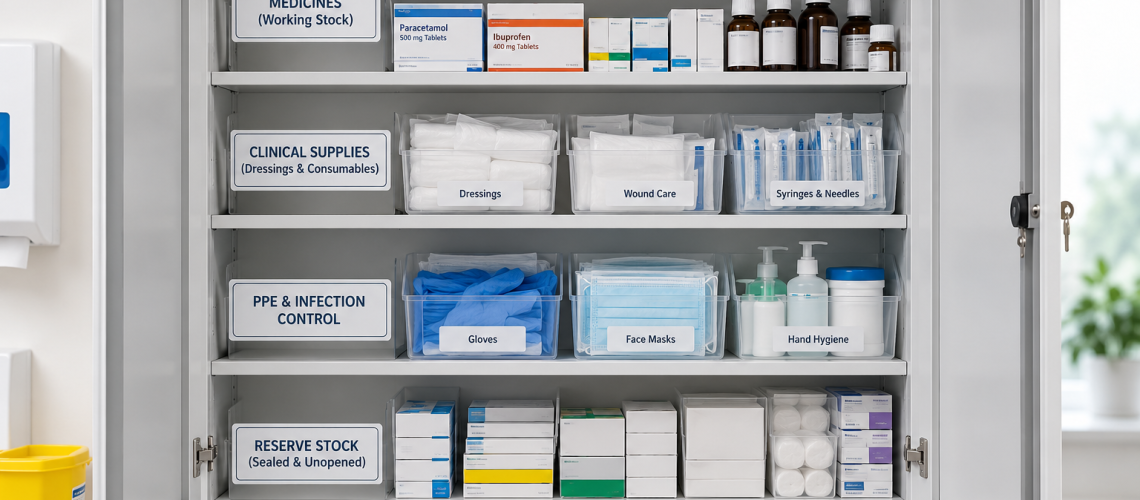
Medical cabinet layout and organisation should make medicines and clinical supplies easier to identify, easier to reach and easier to keep under control. The aim is not to fill every available shelf, but to give each stock group a clear place and enough space to remain visible and manageable.
This guide focuses on the physical organisation of medical cabinets: shelving, stock segregation, working stock, reserve stock, visibility, overcrowding, consistent shelf positions and practical housekeeping.
For broad cabinet selection, use the Medical Cabinets UK guide. For clinic and treatment-room use, see Medical Cabinets for Clinics UK. For recurring stock and expiry checks, use the Medicine Cabinet Audit Checklist UK.
Quick Answer: How Should a Medical Cabinet Be Organised?
Organise a medical cabinet so that each stock group has a clear purpose and location, high-use items remain easy to identify, reserve stock does not crowd the working shelves, unrelated items are kept apart and enough free space remains for safe handling, cleaning and routine checks.
| Organisation question | Practical approach |
|---|---|
| What belongs in the cabinet? | Define the cabinet’s storage role before filling it |
| How should shelves be used? | Assign clear stock groups or functions |
| Where should high-use stock go? | Keep it visible and easy to reach |
| What about reserve stock? | Keep larger quantities away from prime working space where practical |
| How much empty space is needed? | Enough to avoid compression, hidden stock and difficult cleaning |
| How should several cabinets work? | Give each cabinet a defined role rather than duplicating mixed storage |
Why Medical Cabinet Layout Matters
A cabinet can be large enough on paper and still work badly if the internal layout is unclear. Poor organisation creates practical problems such as hidden stock, duplicated items, overcrowded shelves and difficulty seeing what needs replenishment.
- staff spend longer searching for items;
- stock can become hidden behind other packs;
- reserve quantities can crowd out working stock;
- unrelated supplies can gradually become mixed together;
- routine checks and cleaning become harder.
Give Each Cabinet a Clear Storage Role
Before deciding where individual items go, decide what the cabinet itself is for.
- general medicines;
- personal medication;
- dressings and clinical consumables;
- working treatment stock;
- reserve stock;
- first aid supplies.
A cabinet that has no clear purpose tends to become a general dumping space. A defined role makes the internal layout easier to maintain.
Plan the Shelf Layout Around Stock Groups
Shelf layout should make the cabinet understandable at a glance.
- group similar stock together where practical;
- avoid spreading one stock category across several unrelated shelves;
- allow taller packs enough vertical clearance;
- keep frequently used stock in the more convenient shelf positions;
- avoid using the lowest or highest shelf for items that need constant access if that position is awkward for normal users.
Separate Stock by Function
Physical separation helps prevent different storage roles from becoming confused.
| Stock type | Organisation approach |
|---|---|
| General medicines | Keep together within clearly defined shelf areas |
| Personal medication | Keep clearly attributable to the correct person where required |
| Clinical consumables | Keep separate from medicine stock where that improves clarity |
| Reserve stock | Keep apart from normal working quantities where practical |
| First aid supplies | Keep in a clearly defined first aid storage role rather than mixing casually with routine medicines |
Controlled-drug storage is a separate specialist requirement. Use the Controlled-Drug Cabinet UK guide for that subject.
Separate Working Stock from Reserve Stock
One of the simplest ways to improve cabinet organisation is to distinguish between stock needed for day-to-day use and larger reserve quantities.
- Working stock: keep enough for normal daily use in the most practical cabinet or shelf position.
- Reserve stock: keep larger backup quantities in a secondary shelf area, cabinet or storage room where practical.
This reduces pressure on the prime working area and makes the stock that staff need most often easier to identify.
Keep Stock Visible
Good organisation makes it possible to see what is present without moving several other items first.
- avoid packing shelves several rows deep where this hides stock;
- keep labels or identifying information visible where practical;
- avoid stacking packs in unstable or awkward arrangements;
- leave enough room to remove and replace items without disturbing the whole shelf;
- review shelf positions if staff regularly need to move items to find what they need.
Avoid Overcrowded Medical Cabinets
Overcrowding is one of the clearest signs that the layout or capacity no longer matches the storage requirement.
An overcrowded cabinet can make it harder to see stock, clean shelves, rotate items and complete routine checks. Adding more shelves is not always the answer if the underlying problem is simply too much stock for the cabinet.
Signs the Cabinet Is Overcrowded
- stock is stored several rows deep;
- packs are stacked on top of unrelated items;
- shelf labels no longer match what is actually stored there;
- staff regularly move items to reach others;
- reserve stock occupies most of the working area;
- new deliveries have no obvious place to go.
When One Medical Cabinet Is Not Enough
Using two cabinets can be more practical than forcing several storage roles into one oversized or overcrowded unit.
| Situation | Possible organisation approach |
|---|---|
| Working stock plus large reserve quantities | Separate working and reserve storage |
| Medicines plus large quantities of consumables | Separate medicine and clinical-supply cabinets |
| Several treatment rooms | Small working cabinets in rooms plus central reserve storage |
| Different departments or functions | Give each cabinet a defined role rather than mixing stock |
For the wider multi-unit planning question, use Medicine Storage Systems UK.
Use Consistent Shelf Positions Where It Helps
Where several similar treatment or consultation rooms use comparable stock, a consistent layout can make storage easier for staff to understand.
- use similar shelf roles in similar rooms where practical;
- keep frequently used categories in broadly consistent positions;
- avoid unnecessary variation between rooms that serve the same purpose;
- allow local differences where the stock or clinical use genuinely differs.
Organise the Cabinet So It Can Be Cleaned
Good storage organisation should leave enough access to wipe shelves, inspect surfaces and remove damaged or leaking items.
- avoid permanently filling every centimetre of shelf space;
- remove obsolete or unrelated items;
- keep stock arranged so shelves can be reached;
- avoid unstable piles that have to be dismantled whenever cleaning is required.
Medical Cabinet Organisation in Treatment Rooms
In a treatment room, organisation should support quick identification of working stock without turning the cabinet into bulk storage.
- keep high-use items in practical positions;
- keep reserve quantities elsewhere where possible;
- use clear shelf roles;
- avoid unrelated room supplies taking over medicine-storage space;
- keep the internal layout simple enough to maintain consistently.
For the wider treatment-room use case, see Medical Cabinets for Clinics UK.
Good Organisation Makes Audits Easier
Physical organisation supports routine stock checks because items are easier to see, identify and count. It does not replace the audit process itself.
Use the Medicine Cabinet Audit Checklist UK for stock accuracy, expiry control, missing items, cabinet condition, replenishment and follow-up actions.
Common Medical Cabinet Organisation Mistakes
- Filling every shelf completely. This makes stock harder to see and shelves harder to clean.
- Mixing working and reserve stock. Large backup quantities can overwhelm the prime working area.
- Using the cabinet for unrelated room storage.
- Changing shelf positions constantly. Staff lose the benefit of a predictable layout.
- Adding more stock without reviewing capacity.
- Relying on labels instead of physical organisation. Labels help, but they cannot fix an overcrowded or confused layout.
Medical Cabinet Organisation Checklist
- Does the cabinet have a clearly defined storage role?
- Are stock groups easy to distinguish?
- Are high-use items easy to see and reach?
- Is reserve stock kept out of the prime working area where practical?
- Are shelves overcrowded?
- Can items be removed without disturbing several others?
- Can shelves and internal surfaces be cleaned easily?
- Are unrelated items creeping into the cabinet?
- Would a second cabinet or separate reserve area improve the layout?
- Are shelf positions consistent enough for staff to understand the system?
Related Medical Storage Guides
- Medical Cabinets UK – broad cabinet selection and buying guide.
- Medicine Storage Systems UK – wider storage-system planning.
- Medical Cabinets for Clinics UK – clinic and treatment-room use.
- Wall-Mounted vs Floor-Standing Medical Cabinets – cabinet-format comparison.
- Medicine Cabinet Audit Checklist UK – recurring stock, expiry and replenishment checks.
- Medical Cabinet Locks & Access Control UK – lock and authorised-access governance.
Medical Cabinets from Total Locker Service
Total Locker Service supplies lockable medical cabinets for clinics, care settings, schools, workplaces and other staff-managed environments across the UK.
Choose the cabinet around the stock and room, then organise the internal space so that working stock remains visible, reserve quantities remain manageable and each storage area has a clear purpose.
Medical Cabinet Layout & Organisation FAQs
How should a medical cabinet be organised?
Give the cabinet a clear storage role, group related stock together, keep high-use items visible, separate working and reserve stock where practical and avoid overcrowding.
Should reserve medical stock be kept in the same cabinet as working stock?
It can be, but large reserve quantities often make working shelves harder to use. Where practical, keep reserve stock in a separate shelf area, cabinet or clinical storage room.
How do I know if a medical cabinet is overcrowded?
Common signs include stock stored several rows deep, packs stacked on unrelated items, difficulty seeing labels, no clear space for new deliveries and staff regularly moving stock to reach other items.
Is it better to use two medical cabinets instead of one?
Sometimes. Two cabinets can work better when working stock, reserve stock, medicines and clinical consumables have different storage roles and one cabinet would otherwise become overcrowded.
Does medical cabinet organisation help with stock audits?
Yes. Clear shelf roles and visible stock make counting, expiry checks and replenishment easier, although organisation does not replace the recurring audit process.
Conclusion: Give Every Shelf and Cabinet a Clear Role
Good medical cabinet organisation is simple enough to maintain. Give each cabinet a clear purpose, group stock logically, keep high-use items visible, separate reserve quantities where practical and leave enough free space for handling, cleaning and routine checks.
When the cabinet becomes permanently overcrowded or starts serving several unrelated functions, review the storage layout rather than trying to fit more into the same space.
Discover more from Blog Total Locker Service
Subscribe to get the latest posts sent to your email.