Changing Room Bench Materials UK: Wood vs Plastic vs Metal
April 13, 2026
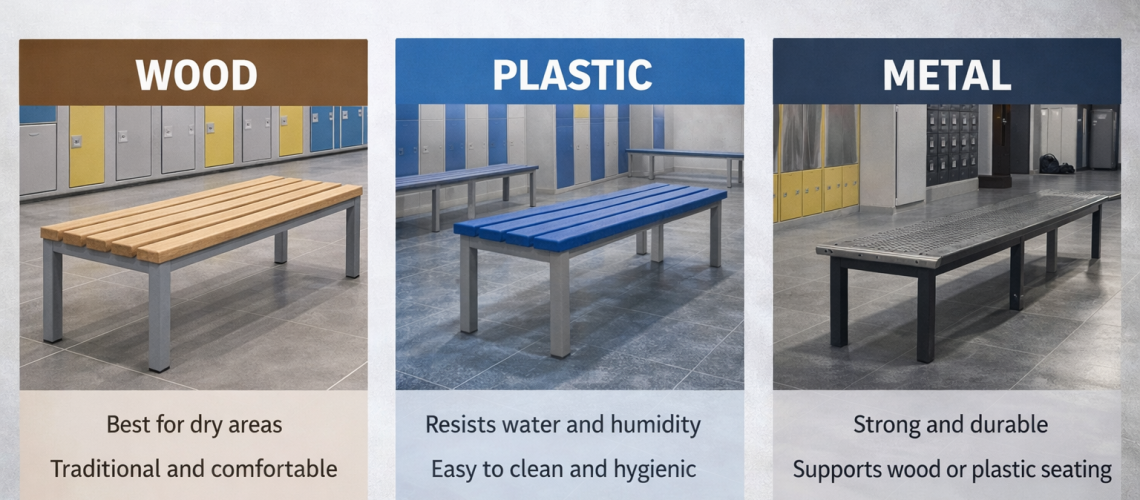
Changing room bench materials affect how seating performs throughout its working life. Moisture resistance, cleaning, durability, comfort and appearance can all change depending on whether the bench uses hardwood slats, plastic construction or a metal supporting frame.
The right material depends primarily on the environment. A bench used in a dry school or workplace changing room faces very different conditions from seating installed beside showers, swimming pools or frequent wash-down areas.
This guide compares wood, plastic and metal changing room benches, explains where each material works best and highlights the trade-offs to consider before specifying seating. For the wider choice of bench types, sizes and configurations, see our Changing Room Bench Selection Guide UK.
To compare current products, browse our changing room bench seating.
Quick answer: which changing room bench material is best?
There is no single best bench material for every changing room. Hardwood slat seating works well in many dry changing areas where appearance and sitting comfort matter. All-plastic benches are particularly useful in wet, humid or frequently cleaned environments because the material does not rot or rust. Metal is most commonly used as the structural frame supporting the seating surface.
The strongest specification starts with the environmental conditions rather than choosing the material on appearance alone.
| Bench material | Best suited to | Main strength | Main consideration |
|---|---|---|---|
| Hardwood slats | Dry schools, workplaces and changing rooms | Comfortable, familiar seating surface | Less suitable for persistent wet exposure |
| Plastic | Pools, showers, wash-down areas and humid rooms | Moisture resistance and easy cleaning | Different appearance and feel from timber |
| Metal | Structural frames and selected heavy-duty applications | Strength and rigidity | Finish must suit the environment |
Why changing room bench material matters
Changing-room seating is exposed to repeated use, footwear, bags, cleaning products and sometimes significant moisture. Material choice therefore influences more than appearance.
- Durability: how well the bench withstands repeated daily use.
- Moisture resistance: whether humidity, splashing or wet clothing are likely to damage the seating.
- Cleaning: how easily surfaces, joints and areas underneath can be maintained.
- Comfort: how the seating surface feels during normal changing.
- Maintenance: whether finishes or components need periodic attention.
- Appearance: how the bench fits the wider changing-room design.
Material should therefore be considered alongside bench position, room zoning and the cleaning regime rather than as an isolated product decision.
Hardwood slat changing room benches
Hardwood slat benches are a traditional choice for dry changing rooms. Total Locker Service supplies bench seating using hardwood slats on powder-coated steel frames, providing a familiar sitting surface with a strong supporting structure.
Advantages of hardwood bench seating
- comfortable seating surface;
- traditional changing-room appearance;
- suitable for many dry school and workplace applications;
- works well with steel supporting frames; and
- can provide a warmer visual finish than all-plastic or all-metal seating.
When hardwood needs more careful consideration
Timber is not normally the first choice where the seating is exposed continuously to water, heavy humidity or frequent wash-down cleaning. Repeated wetting can increase maintenance requirements and reduce suitability compared with materials intended specifically for those conditions.
- Check whether the room is genuinely dry or only appears dry during quiet periods.
- Consider wet footwear and clothing brought back from showers.
- Check the cleaning products and methods used on the site.
- Avoid assuming that all timber constructions have identical moisture resistance.
For mixed environments, use our Changing Room Layout Guide: Wet vs Dry Areas to identify where different materials may be needed within the same room.
Plastic changing room benches
All-plastic bench seating is designed for environments where resistance to water, corrosion and frequent cleaning are high priorities. This makes it particularly useful around swimming pools, showers, wash-down areas and wet industrial changing facilities.
Total Locker Service’s plastic seating is rust-free and uses non-porous surfaces designed for straightforward deep cleaning, making it substantially different from a conventional timber-and-steel bench construction.
Advantages of plastic bench seating
- does not rot or rust;
- suitable for high-moisture environments;
- non-porous surfaces are straightforward to wipe and deep clean;
- useful where regular wash-down cleaning is required;
- avoids timber splinters and chipped painted seating surfaces; and
- can be used for both seating and integrated changing-room furniture configurations.
Considerations when choosing plastic benches
- The visual appearance is different from hardwood seating.
- Bench dimensions and construction still need to suit the user group.
- Wet-area suitability does not remove the need for suitable drainage and room ventilation.
- Cleaning access around and underneath the bench still needs to be planned.
For pools, showers and regularly wet environments, see our Wet Area Changing Room Design guide.
What role does metal play in changing room benches?
Metal is commonly used to provide the structural frame rather than the sitting surface itself. On standard dry-area bench seating, a powder-coated steel frame can support hardwood slats while providing rigidity and stability.
The frame construction affects:
- overall bench strength;
- stability;
- connection between legs, rails and seating;
- ability to support integrated hooks or additional furniture; and
- long-term resistance to movement under repeated use.
However, the finish must suit the environment. A metal frame that performs well in a normal dry changing room should not automatically be assumed suitable for prolonged exposure to poolside moisture, aggressive cleaning or corrosive conditions.
Wood vs plastic vs metal: changing room bench comparison
| Factor | Hardwood slats | Plastic | Metal |
|---|---|---|---|
| Dry changing rooms | Very suitable | Suitable | Common as supporting frame |
| Wet changing rooms | Requires careful specification | Particularly suitable | Depends on construction and finish |
| Water resistance | Lower than plastic | High | Depends on metal and protective finish |
| Cleaning | Requires appropriate care | Non-porous and straightforward to clean | Depends on surface and joints |
| Traditional appearance | High | Lower | More functional/industrial |
| Structural role | Usually seating surface | Can form complete bench | Frequently used for frames |
| Best selection driver | Dry use and appearance | Moisture and cleaning | Strength and structural support |
Bench materials for wet and dry changing rooms
The boundary between wet and dry use is one of the most important factors in bench selection.
A dry changing area is normally used for personal storage and changing without routine direct exposure to showers or pool water. These rooms generally allow greater flexibility in bench materials.
A wet changing area may experience regular water from showers, pools, wet swimwear, footwear or wash-down cleaning. Material selection needs to reflect that exposure.
| Planning factor | Dry area | Wet area |
|---|---|---|
| Typical moisture | Low to moderate | Regular or persistent |
| Bench priority | Comfort, strength and appearance | Moisture resistance and cleaning |
| Material flexibility | Higher | More restricted |
| Hardwood seating | Commonly appropriate | Requires careful specification |
| All-plastic seating | Can be used | Particularly well suited |
| Main maintenance issue | General wear and cleaning | Water, humidity, cleaning and drainage |
For complete room planning, see our Changing Room Layout Guide UK: Wet vs Dry Areas. It covers lockers, benches, drainage, circulation and the transition between zones.
Mixed wet and dry rooms may need more than one bench material
A changing room does not always need one bench specification throughout. A facility containing a dry locker zone and a wetter shower or pool transition may justify different seating materials in different locations.
For example, a dry changing area could use hardwood slat benches while the wetter shower-side zone uses plastic seating. This allows each material to be used where its properties are most useful.
Our Locker Room Zoning Guide UK explains how wet, dry, changing and circulation zones can be separated within the same facility.
Cleaning should influence bench material choice
The cleaning regime matters almost as much as the presence of water. A bench in an apparently dry environment may still be exposed to frequent disinfecting, wash-down procedures or harsh cleaning conditions.
Consider:
- how often the bench is cleaned;
- whether surfaces are wiped or washed down;
- which cleaning products are used;
- whether water can collect around legs or feet;
- whether dirt can accumulate beneath the bench; and
- whether all surfaces remain accessible for inspection.
For wider housekeeping and lifecycle guidance, see our Changing Room Cleaning & Maintenance guide.
Bench construction matters as well as material
Two benches made from the same basic material can still perform differently because of their construction. Frame design, joints, feet, fixings and slat spacing all affect how the finished product behaves.
Check:
- seat depth;
- bench length;
- frame construction;
- feet and floor contact;
- whether the unit is freestanding or fixed;
- quality of joints and fasteners;
- ease of access beneath the seating; and
- whether damaged components can be replaced.
The complete bench specification should therefore be compared rather than selecting solely on whether the seat is described as wood, plastic or metal.
Which bench material works best in schools?
Dry school changing rooms commonly suit hardwood slat seating on a robust supporting frame. The familiar construction provides a practical sitting surface while coping with regular pupil use.
Where the school facility includes showers or repeatedly wet changing areas, the specification should reflect the actual moisture exposure rather than assuming one bench type should be used throughout.
Layout, supervision, pupil numbers and cleaning also matter, so bench material should form part of the wider changing-room plan.
Which bench material works best in workplaces?
Many staff changing rooms are predominantly dry and can use hardwood slat seating effectively. Industrial workplaces can be more demanding where mud, wet workwear, boots, PPE or frequent cleaning are involved.
In those environments, ask whether moisture resistance and cleanability justify plastic seating or whether the dry changing area remains suitable for a conventional timber-and-metal construction.
For complete staff-changing requirements, see our Workplace Changing Rooms guide.
Which bench material works best in gyms and leisure centres?
The answer depends on where the bench sits within the facility. A bench in a dry gym changing area may experience very different conditions from seating immediately beside showers or a swimming pool.
Where towels, swimwear and wet footwear regularly introduce moisture, an all-plastic construction can reduce concerns around rot, rust and moisture absorption.
For heavily wet areas, see our dedicated Wet Area Changing Room Design guide.
Material choice and bench positioning should be considered together
A moisture-resistant bench can still perform badly if it is placed where it obstructs drainage, traps dirt or restricts movement around lockers.
Bench positions should allow:
- users to sit and stand comfortably;
- nearby locker doors to open;
- people to move through the room;
- cleaning around and beneath the bench;
- wet areas to drain as intended; and
- maintenance staff to inspect the furniture.
The Locker Planning UK guide covers the wider relationship between lockers, benches, circulation and changing-room space.
Do not choose bench material on purchase price alone
The cheapest initial option can become poor value if the material is unsuitable for the room. Premature corrosion, swelling, damaged finishes or difficult cleaning can all increase maintenance and replacement costs.
Compare the likely whole-life requirement:
- expected service conditions;
- cleaning frequency;
- moisture exposure;
- intensity of use;
- maintenance requirements;
- availability of replacement components; and
- the cost and disruption of premature replacement.
Common bench material mistakes
- Choosing on appearance alone: environmental exposure should come first.
- Using dry-area seating in persistently wet conditions: a suitable wet-area construction may last better and require less maintenance.
- Assuming all plastic benches are identical: compare the complete construction, dimensions and specification.
- Assuming every metal frame is suitable for wet use: metal type and protective finish matter.
- Ignoring cleaning access: material alone does not make a bench hygienic.
- Ignoring the surrounding room: drainage, humidity and ventilation still affect performance.
- Using one bench specification across different zones automatically: mixed wet/dry rooms may benefit from different materials.
Changing room bench material checklist
- Is the bench area dry, damp or regularly wet?
- Will wet towels, footwear or clothing contact the bench?
- How frequently will the seating be cleaned?
- Is wash-down cleaning required?
- How heavily will the bench be used?
- Is appearance an important part of the room design?
- Does the frame construction suit the environment?
- Can the floor beneath the bench be cleaned easily?
- Are corrosion, rot or moisture absorption realistic risks?
- Would different zones benefit from different bench materials?
Choose the bench material for the environment
The most appropriate changing room bench material is the one that matches the conditions in which the seating will actually operate.
Hardwood slat seating is a practical choice for many dry school, workplace and commercial changing rooms. All-plastic seating is particularly useful where water, humidity and intensive cleaning are regular features. Metal commonly provides the structural strength behind dry-area seating, but its finish and exposure still need to be considered.
For current products, browse our changing room bench seating. For the complete selection process, continue with our Changing Room Bench Selection Guide UK. If the project includes showers, pools or regular wet use, read our Wet Area Changing Room Design guide.
Discover more from Blog Total Locker Service
Subscribe to get the latest posts sent to your email.