Cash Safe Replacement Guide UK: When to Repair, Upgrade or Replace a Business Safe
September 24, 2026
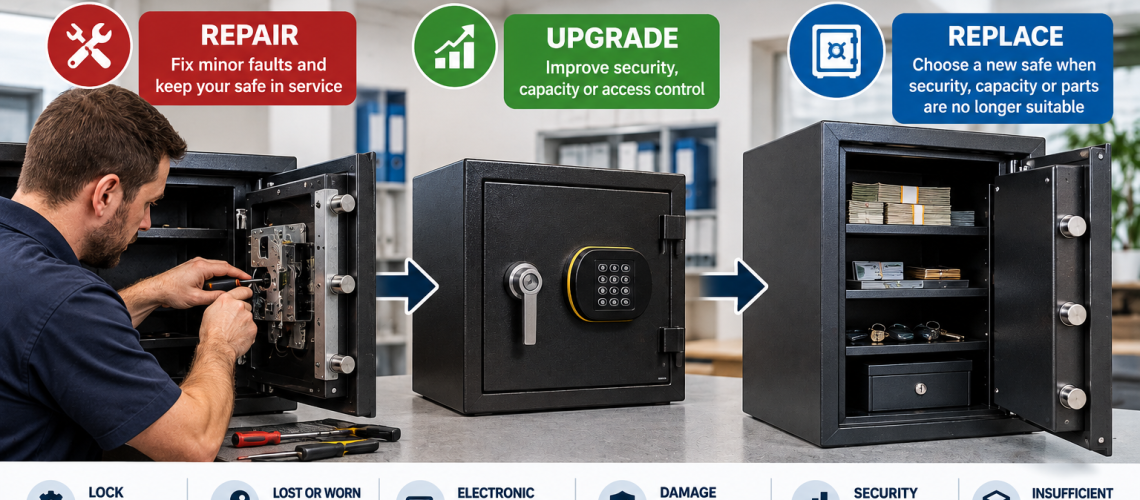
A business cash safe does not need replacing simply because it is old. A well-made safe can remain useful for many years if its structure, lock, door, boltwork and anchoring remain sound. Replacement becomes more sensible when security requirements have changed, faults are recurring, parts are unavailable, access control no longer suits the business or the safe no longer provides the capacity or rating required.
This guide explains when a UK business should repair, upgrade or replace a cash safe, including lock faults, worn keys, electronic-lock problems, damaged doors, loose anchoring, outdated security levels, insufficient capacity, relocation and changes to insurance requirements.
Quick Answer: When Should a Cash Safe Be Replaced?
Replace a cash safe when it no longer provides the required level of security, cannot be repaired economically, has significant structural or lock damage, cannot be securely anchored, is too small for current use, relies on obsolete parts or no longer meets insurer or business requirements. Minor lock, key, battery or alignment faults may often be repairable without replacing the complete safe.
| Safe condition | Action to consider |
|---|---|
| Good safe with worn or damaged key | Inspect or replace the key |
| Good safe with weak electronic-lock battery | Replace the battery correctly |
| Sound safe with repairable lock fault | Repair or replace the lock where suitable |
| Safe remains secure but access method is outdated | Consider a compatible lock upgrade |
| Safe is too small for current contents | Replace with an appropriately sized safe |
| Security rating is no longer sufficient | Upgrade to a suitable higher-security safe |
| Major structural or attack damage | Assess for replacement |
| Safe cannot be securely anchored | Review installation or replace the safe |
Does an Old Cash Safe Need Replacing?
Age alone is not enough to decide whether a cash safe should be replaced.
An older safe may still be suitable if:
- the body remains structurally sound;
- the door closes correctly;
- the lock works reliably;
- the boltwork operates smoothly;
- the safe remains securely anchored;
- the internal capacity still suits the business;
- the security level remains appropriate;
- replacement parts and service remain available.
A relatively modern safe can become unsuitable quickly if the value being protected increases, the business changes how staff access it or the safe suffers significant damage.
Repair or Replace a Cash Safe?
The decision should begin by identifying whether the problem affects one repairable component or the safe as a complete security product.
Repair may be sensible when:
- a key is worn or damaged;
- an electronic lock needs a battery replacement;
- a compatible lock can be serviced or replaced;
- a handle or operating component has a repairable fault;
- minor door alignment can be corrected;
- internal shelves or fittings need replacement;
- the safe still provides the required security level.
Replacement may be more sensible when:
- structural security has been compromised;
- the safe has serious attack damage;
- the lock or essential components are obsolete;
- faults are recurring;
- repair cost is disproportionate to the remaining value of the safe;
- the required cash rating has increased;
- the safe is too small;
- the access system no longer suits the business;
- the installation cannot be made suitably secure.
For routine inspection and warning signs, see Cash Safe Maintenance & Inspection UK.
Does a Failed Safe Lock Mean the Whole Safe Must Be Replaced?
Not necessarily. A lock may be serviceable or replaceable while the safe body remains structurally sound and suitable for continued use.
Compatibility still matters. A replacement lock should suit the safe and, where relevant, preserve the security level required by the installation or insurer.
Do not assume that any electronic keypad or mechanical lock can simply be fitted to any safe.
For lock-selection considerations, see Key vs Electronic Cash Safes UK.
Lost or Damaged Safe Keys
A lost or damaged key does not automatically justify replacing the safe.
First establish:
- whether a valid spare key exists;
- whether the key can be legitimately replaced;
- whether the lost key creates a security concern;
- whether the lock can be changed;
- whether the current key system still suits the organisation.
If an uncontrolled key may still provide access, the security issue is different from simply having no working key available.
Electronic Lock Problems
Electronic-lock problems can range from simple battery issues to faults requiring specialist attention.
- weak or flat batteries;
- unresponsive keypad buttons;
- forgotten user codes;
- damaged keypad housings;
- intermittent operation;
- failed electronic components;
- obsolete lock models.
A battery issue is very different from an obsolete or failed lock with no practical replacement route. Follow the manufacturer’s access and battery procedures rather than forcing or dismantling the safe.
When Door Damage Becomes a Replacement Issue
The door is a critical part of the safe’s security construction.
Replacement should be considered where damage affects:
- door alignment;
- locking-bolt engagement;
- hinges;
- lock mounting;
- door structure;
- closing accuracy;
- resistance to forced entry.
Cosmetic scratches are not the same as structural deformation. The important question is whether the safe still closes, locks and provides the required level of protection.
Safe Damage After an Attempted Break-In
A safe that has been attacked should be inspected before being returned to normal service.
Possible damage may affect:
- the lock;
- keypad;
- handle;
- boltwork;
- hinges;
- door edges;
- safe body;
- anchoring;
- surrounding floor or wall.
A safe can still appear closed and operational while having sustained damage that affects future security. Significant attack damage is therefore a stronger reason for replacement than ordinary cosmetic wear.
When the Safe’s Security Rating Is No Longer Enough
A fully functioning safe may still need replacing if the business now stores more valuable contents than it did when the safe was purchased.
This can happen when:
- turnover increases;
- more cash remains overnight;
- banking frequency decreases;
- several tills are consolidated into one safe;
- higher-value items are added;
- insurance requirements change;
- the site’s risk profile changes.
In this situation, the old safe may still work mechanically but no longer provide the level of protection required.
For safe standards and cash ratings, see Insurance Rated Safe UK: EN 14450 vs EN 1143.
When a Cash Safe Has Become Too Small
Insufficient capacity is a common reason to upgrade even when the existing safe remains secure.
Warning signs include:
- the safe is routinely full;
- cash bags obstruct the door;
- contents interfere with boltwork;
- till drawers no longer fit;
- important items are stored outside because there is no space;
- busy periods exceed available capacity.
Repeated overfilling is usually evidence that the storage requirement has outgrown the safe.
See Cash Safe Size Guide UK before choosing a replacement.
When the Access Method No Longer Works for the Business
A safe can remain mechanically reliable while its access method becomes operationally unsuitable.
- too many physical keys are in circulation;
- staff change frequently;
- shared electronic codes are difficult to control;
- more authorised users are required;
- dual control is now required;
- time delay is now required;
- accountability around current access is poor.
If the safe supports a suitable lock upgrade, complete replacement may not be necessary. If it does not, upgrading the safe may provide a better long-term solution.
When Anchoring Problems Affect Safe Suitability
A safe that cannot be anchored appropriately at its current location may not provide the intended security.
Before replacing the safe, determine whether the problem is actually the installation position.
- Can the existing safe be relocated to a suitable structural surface?
- Are the original fixing points still usable?
- Has the floor or wall construction changed?
- Has the safe been moved without being re-anchored?
- Does the manufacturer permit another approved fixing method?
If no suitable approved installation can be achieved, replacement with a different safe may be necessary.
See Cash Safe Installation & Fixing UK.
Obsolete Safe Locks and Parts
Parts availability can determine whether repair remains practical.
An older safe may become increasingly difficult to support if:
- the original manufacturer no longer supports the model;
- replacement locks are unavailable;
- key blanks are difficult to source;
- electronic components are obsolete;
- specialist repairs cost more than replacement;
- compatible parts could compromise the original specification.
Obsolescence does not automatically make a safe insecure, but it can make future faults increasingly difficult and expensive to resolve.
Should You Replace a Safe When Moving Premises?
A business move is a useful point to review whether the existing safe remains appropriate.
- Is the safe worth moving?
- Can it be transported safely?
- Does it fit the new delivery route?
- Can it be anchored correctly at the new site?
- Does its security rating still suit current holdings?
- Is its capacity still sufficient?
- Would replacement avoid significant moving costs?
Heavy high-security safes can be difficult to relocate, so moving cost should be considered alongside the safe’s remaining usefulness.
Business Growth Can Outgrow a Safe Before the Safe Wears Out
Many safe replacements are driven by business change rather than physical failure.
A business may originally buy a compact safe for:
- petty cash;
- one till;
- one company card;
- a few keys;
- small daily takings.
Several years later it may operate multiple tills, retain more cash, store additional valuables or require access for several managers. The safe has not necessarily failed; the requirement has changed.
When Repair Cost Becomes Poor Value
Repair can be worthwhile when it restores a suitable safe to reliable service at reasonable cost.
Replacement becomes more attractive when:
- several repairs are required;
- faults repeatedly return;
- parts are expensive or difficult to obtain;
- the safe is already too small;
- the security level is already marginal;
- a new safe would solve several existing problems at once.
Do not compare repair cost only with the purchase price of a new safe. Also consider installation, movement, downtime and the remaining usefulness of the existing unit.
What Should You Upgrade To?
Replacement is an opportunity to correct the limitations of the old safe.
- required cash rating;
- valuables rating;
- internal dimensions;
- number and position of shelves;
- lock type;
- number of authorised users;
- dual-control requirements;
- time-delay requirements;
- deposit facilities;
- installation and anchoring;
- delivery route;
- future growth.
Browse TLS safes or high-security safes where greater burglary resistance is required.
Keep, Repair, Upgrade or Replace?
| Condition | Route to investigate |
|---|---|
| Safe fully functional and suitable | Keep in service and maintain |
| Minor key or battery issue | Repair or replace the affected component |
| Repairable lock fault | Service or compatible lock replacement |
| Access method outdated | Assess lock upgrade |
| Safe too small | Replace with larger suitable model |
| Security rating insufficient | Upgrade safe |
| Major structural damage | Assess replacement |
| Parts unavailable and faults recurring | Replacement may offer better long-term value |
Cash Safe Replacement Checklist
- Does the safe still open and close correctly?
- Does the lock operate reliably?
- Are all authorised keys accounted for?
- Is the electronic lock still supported?
- Are replacement parts available?
- Has the safe suffered attack or structural damage?
- Is the anchoring still secure?
- Does the safe still meet the required cash rating?
- Does it still meet insurer requirements?
- Is the internal capacity sufficient?
- Does the current lock suit the number of users?
- Are faults becoming more frequent?
- Is repair economically sensible?
- Would a replacement solve several problems at once?
- Can the replacement be delivered and installed correctly?
- What future growth should be allowed for?
Cash Safe Replacement FAQs
How long does a cash safe last?
There is no single lifespan for every cash safe. A suitable safe can remain useful for many years if its structure, lock, door, anchoring and security level remain appropriate.
Should an old cash safe be replaced?
Not simply because of age. Condition, security rating, parts availability, capacity and current business requirements are more useful criteria.
Can a cash safe lock be replaced?
Some safe locks can be serviced or replaced, but compatibility and any security requirements should be checked before changing the lock.
Should I replace a safe after a break-in attempt?
The safe should be inspected for damage to the lock, door, hinges, boltwork, body and anchoring. Significant security damage may justify replacement.
Should I replace a safe that is too small?
If the safe is regularly overfilled or contents obstruct normal operation, a larger suitable safe may provide a better long-term solution.
Can I upgrade a key safe to an electronic lock?
Possibly, depending on the safe and the compatible lock options available. Do not assume every safe can accept every lock type.
Should a safe be replaced when a business moves?
Not automatically. Compare relocation cost, remaining suitability, new-site anchoring, access and current security requirements with the cost of replacement.
Can changed insurance requirements mean changing the safe?
Yes. If the existing safe no longer satisfies the required security or cash rating, a higher-rated replacement may be necessary.
When is repairing a safe poor value?
Replacement becomes more attractive when faults are recurring, parts are obsolete, repair costs are high or the safe is already unsuitable in size or security level.
What should I check before buying a replacement safe?
Check the required security rating, maximum cash value, internal capacity, lock type, authorised users, installation, anchoring, delivery route and future growth.
Replace a Cash Safe When the Requirement Has Outgrown the Safe
A cash safe does not need replacing simply because it has reached a particular age. Stronger reasons include loss of security, recurring faults, structural damage, obsolete components, insufficient capacity or a change in the value and type of contents being protected.
Repair minor faults where doing so restores a suitable safe to reliable service. Consider an upgrade where the safe body remains sound but the access method needs to change. Replace the complete safe where its security, capacity or long-term support no longer matches the business requirement.
Using condition and operational evidence rather than age alone helps avoid both unnecessary replacement and keeping an unsuitable safe in service for too long.
Related Cash Safe Guides and Products
Discover more from Blog Total Locker Service
Subscribe to get the latest posts sent to your email.