Locker Lock Number Plates & Escutcheons UK: Numbering, Replacement & Refurbishment
September 30, 2026
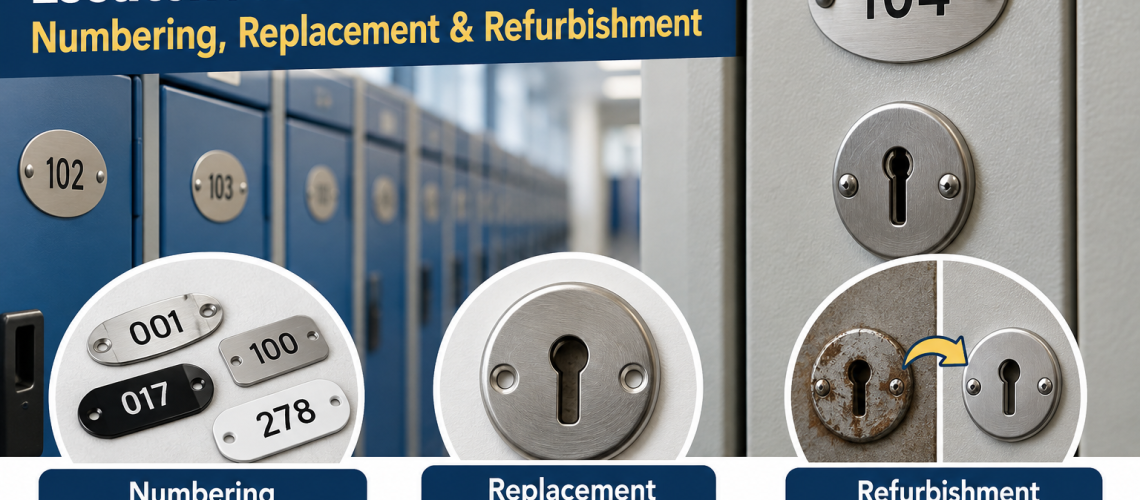
Locker lock number plates and engraved escutcheons provide a simple way to identify individual lockers while also creating a neat finishing point around the lock cylinder.
They are particularly useful when refurbishing existing locker banks, replacing missing or damaged identification, renumbering lockers, fitting replacement locks or bringing an older installation back to a consistent standard.
Unlike a separate locker number plate positioned elsewhere on the door, a numbered locker lock escutcheon places the locker reference directly around the cylinder. This keeps the lock and identification together and can make large locker installations easier for users and facilities teams to manage.
Total Locker Service manufactures custom numbered locker lock escutcheon plates for selected compatible ASSA and Lowe & Fletcher Classic locker locks. Options include custom numbers or short references, different engraving-laminate colours, round or Double-D cylinder apertures, style choices and selectable Braille configurations.
This guide explains what locker escutcheon plates are, how they differ from conventional number plates, when they should be replaced, how to check lock compatibility and how engraved identification can support locker refurbishment and long-term estate management.
Quick Answer: What Is a Locker Lock Escutcheon Plate?
A locker lock escutcheon plate is a shaped plate fitted around the visible lock cylinder on the front of a locker door.
Depending on the design, it can perform several functions:
- identify the locker number;
- provide a neat finish around the lock opening;
- replace a missing or damaged original plate;
- cover marks left by an older lock or escutcheon;
- support locker renumbering;
- provide consistent identification during refurbishment;
- use colour to distinguish locker areas;
- incorporate a Braille option where required by the project specification.
The plate is not the lock itself. It sits around the lock cylinder and provides identification and finishing rather than access control.
If the locking mechanism also requires replacement, see our range of replacement locker locks.
Locker Number Plate or Lock Escutcheon?
Both products can identify a locker, but they are not the same thing.
| Feature | Separate locker number plate | Numbered lock escutcheon |
|---|---|---|
| Primary purpose | Identify the locker | Identify the locker and finish around the lock |
| Position | Anywhere suitable on the door | Directly around the lock cylinder |
| Lock aperture required | No | Yes |
| Lock compatibility critical | No | Yes |
| Useful for refurbishment | Yes | Particularly useful where the lock area also needs renewal |
| Can be numbered | Yes | Yes |
| Can use colour coding | Yes | Yes |
A conventional engraved plate may be the simplest solution where only locker numbering is required.
A numbered escutcheon becomes more useful where the identification is intended to sit around the lock or where an existing escutcheon needs replacing.
For the broader subject of locker numbering, see our guide to engraved locker tags and numbering.
Why Locker Escutcheon Plates Matter
A locker can operate perfectly well without decorative identification, but commercial locker estates depend on clear references.
Consider a workplace changing room containing 300 similar locker doors. If a user reports that “the lock on one of the lockers in the middle row is broken”, maintenance staff still have to find it.
If the same report says “locker 184 has a damaged lock”, the problem is immediately more specific.
Numbering supports:
- locker allocation;
- fault reporting;
- maintenance records;
- replacement key ordering;
- lock replacement;
- asset registers;
- user support;
- refurbishment planning;
- capacity management;
- future locker-bank extensions.
Placing the identifier around the lock creates an especially obvious reference point because users naturally look towards the lock when opening or closing the locker.
Where Numbered Locker Escutcheons Are Used
Numbered locker lock plates can be useful anywhere a compatible keyed locker installation needs durable identification.
- schools and colleges;
- workplaces;
- factories;
- warehouses;
- leisure centres;
- gyms;
- sports facilities;
- staff changing rooms;
- healthcare sites;
- council facilities;
- commercial changing areas;
- multi-site locker estates.
The application is normally driven less by the sector than by the actual lock fitted to the locker and the need for consistent identification.
Replacing Missing Locker Lock Number Plates
Missing escutcheons are common on older locker installations.
They may have been removed during previous lock replacement, damaged by repeated use, detached as adhesive aged or lost during refurbishment.
A missing plate can leave the locker looking unfinished and may also remove its visible number.
Where the underlying lock remains suitable, replacing only the escutcheon can be a much smaller intervention than replacing the complete lock.
Before ordering, check:
- the existing lock manufacturer where identifiable;
- the cylinder profile;
- the shape of the existing aperture;
- the dimensions of any surviving escutcheon;
- the locker number or reference required;
- the colour and style of neighbouring plates;
- whether the surrounding door surface is suitable for the selected fixing method.
Do not assume that two visually similar locker locks use the same opening.
Replacing Damaged or Unreadable Escutcheons
An escutcheon does not need to be completely missing before replacement becomes worthwhile.
Replacement may be appropriate where:
- the engraved number is no longer easy to read;
- the plate is cracked;
- corners have lifted away from the locker door;
- the lock opening has become damaged;
- the old plate no longer matches neighbouring lockers;
- the locker has been renumbered;
- a replacement lock has changed the required aperture;
- the existing identification scheme is being standardised.
When replacing only a small number of plates, matching the surviving installation usually produces the most coherent result.
Where a significant proportion are damaged or inconsistent, replacing the entire set may sometimes be easier than maintaining several generations of different identification.
Locker Renumbering
Locker numbers sometimes need to change even though the lockers themselves remain usable.
This can happen following:
- changing-room alterations;
- locker-bank relocation;
- additional lockers being installed;
- removal of old lockers;
- departmental restructuring;
- a change from assigned to shared use;
- a new facilities-management system;
- merging previously separate locker areas.
Engraved escutcheon plates provide one way to introduce the new visible numbering without replacing the locker doors.
Before renumbering, decide whether the new sequence needs to correspond with:
- key fobs;
- spare-key records;
- locker allocation records;
- asset registers;
- maintenance systems;
- floor plans;
- department or room references.
Changing the plate is easy. Changing an entire administrative system after the plates have been fitted is much harder.
Planning a Locker Numbering Sequence
The simplest numbering system that uniquely identifies every locker is usually the best one.
For a single changing room, that may simply be:
001, 002, 003, 004…
A larger site may benefit from prefixes:
- A001, A002, A003;
- B001, B002, B003;
- GF001 for ground floor;
- FF001 for first floor;
- WH1-001 for warehouse 1;
- POOL-01 for a leisure locker area.
The numbered locker escutcheon plate can accept a custom number or short alphanumeric reference of between one and six letters or numbers. :chatgpt-content-reference{index=”0″}
That makes straightforward sequential numbering and compact location prefixes practical without turning the locker door into a complex asset label.
Leave Space for Future Lockers
One of the most common numbering mistakes is designing a sequence that works only for the lockers installed today.
If a site currently has 96 lockers but another bank may be added later, a format such as 001–096 leaves much more room for expansion than an informal mixture of single- and double-digit numbering.
The same principle applies to prefixes.
If two changing rooms both contain locker 1, a maintenance team may eventually encounter ambiguity. Giving each room its own prefix resolves the problem before it develops.
Locker Refurbishment and Numbered Escutcheons
Numbered escutcheon plates are particularly useful during locker refurbishment because many locker cabinets remain structurally sound long after individual accessories begin to look tired.
A refurbishment programme might include:
- cleaning locker doors;
- repairing hinges;
- replacing damaged locks;
- cutting replacement keys;
- renewing number plates;
- fitting new escutcheons;
- standardising locker numbers;
- replacing missing key fobs;
- updating allocation records.
If the locker body and door remain serviceable, this targeted approach can extend the useful life of the installation without automatically replacing every cabinet.
The decision should be based on the overall condition of the locker rather than on the appearance of one inexpensive component.
When to Replace the Plate Only
Replacing only the escutcheon makes sense where:
- the lock operates correctly;
- the cylinder is secure;
- the key works reliably;
- the cam and fixing remain serviceable;
- the locker door is sound;
- only the identification or finishing plate is damaged.
In that situation, changing a functional lock simply to obtain a new visible number would be unnecessary.
When the Locker Lock Should Also Be Replaced
An attractive new escutcheon cannot correct a worn or inappropriate lock.
Consider replacing the lock as well where:
- the cylinder is loose;
- the key regularly jams;
- the lock body is damaged;
- the cam no longer secures the door correctly;
- the key cannot be replaced;
- the mechanism is heavily worn;
- security requirements have changed;
- the existing lock type no longer suits the way the locker is used.
Total Locker Service supplies key-operated, hasp, coin, mechanical combination, keypad and RFID locker locks, so a failing lock does not have to be replaced automatically with the same access method if the operational requirement has changed. :chatgpt-content-reference{index=”1″}
See our locker locks and replacement locker locks section if the lock itself is part of the problem.
ASSA and Lowe & Fletcher Locker Lock Compatibility
The Total Locker Service numbered escutcheon is available for selected compatible ASSA and Lowe & Fletcher Classic locker-lock configurations. :chatgpt-content-reference{index=”2″}
That does not mean every ASSA or Lowe & Fletcher lock automatically accepts the same plate.
Commercial lockers can remain in service for decades. During that time they may have had:
- original manufacturer locks;
- replacement locks;
- refurbished locks;
- different cylinders fitted to part of the estate;
- locks transferred between doors;
- previous non-standard repairs.
The actual lock fitted today is therefore more important than the brand name printed on the locker.
Check the cylinder and existing escutcheon directly before ordering.
Round and Double-D Lock Apertures
The central opening in the escutcheon must match the profile required by the lock cylinder.
The product is available with:
- round cylinder aperture;
- Double-D cylinder aperture.
The current product specification deliberately does not state a universal aperture dimension because the selected opening needs to match the existing lock cylinder or confirmed replacement lock. :chatgpt-content-reference{index=”3″}
This is an important distinction.
Do not measure only the visible front of the lock and assume that the underlying cylinder profile is round. A Double-D profile contains flats that help prevent rotation and needs the corresponding plate opening.
How to Identify the Existing Locker Lock
If the lock cannot be identified confidently, gather more information before ordering the escutcheon.
Useful details include:
- a clear photograph of the front of the lock;
- a photograph of the rear mechanism;
- the cam shape;
- any manufacturer markings;
- the key number or series;
- the locker manufacturer if known;
- the dimensions of the existing plate;
- the cylinder profile;
- the locker-door material.
Total Locker Service’s lock-identification service uses photographs of the front and rear of the lock, cam, locker door and any manufacturer or key markings to help establish the correct replacement route. :chatgpt-content-reference{index=”4″}
That identification work can prevent an inexpensive plate order from becoming an expensive mistake across hundreds of lockers.
Locker Escutcheon Plate Size
The Total Locker Service custom numbered escutcheon measures 45 mm wide × 97 mm high. It is manufactured from ABS engraving laminate and supplied with self-adhesive backing. :chatgpt-content-reference{index=”5″}
Those dimensions matter when replacing an existing plate because the new escutcheon may need to cover:
- the previous plate footprint;
- minor marks around the lock;
- old adhesive residue;
- small differences in finish around the cylinder opening.
Measure the available flat area around the lock before ordering, particularly where the lock sits near a door edge, ventilation pattern, label recess or other fitting.
ABS Engraving Laminate
The standard escutcheon material is ABS engraving laminate. :chatgpt-content-reference{index=”6″}
Engraving laminate is particularly useful for identification because the engraved character exposes a contrasting layer beneath the surface.
This can provide:
- clear permanent numbering;
- strong contrast;
- consistent repeated production;
- different colour combinations;
- a lightweight plate;
- easy production of sequential numbers;
- custom alphanumeric references.
Unlike a temporary paper or printed label, the number is physically engraved into the laminate surface.
For the broader range of identification formats, visit our engraved products section.
Locker Escutcheon Colours
The current numbered escutcheon range includes standard laminate colours such as black, blue, green, grey, red, white and yellow, together with metallic-effect options including brushed gold, brushed silver, gold and silver. :chatgpt-content-reference{index=”7″}
Colour can be used in several ways.
Match the Existing Locker Installation
A neutral or existing colour can make replacement escutcheons blend into an older locker bank.
Create Contrast
A contrasting plate can make the locker number easier to locate quickly.
Colour-Code Locker Areas
Different colours can distinguish:
- locker banks;
- departments;
- floors;
- changing rooms;
- staff groups;
- zones;
- buildings.
Colour should normally supplement the engraved number rather than replace it. Users should still be able to identify the locker from its written or numerical reference.
Matching Existing Escutcheon Colours
Matching an old plate precisely can become difficult because materials change appearance over time.
Existing plates may have experienced:
- UV exposure;
- cleaning products;
- surface wear;
- scratching;
- discolouration;
- years of handling.
Screen colours are also only indicative and can vary according to the display, lighting and material finish. :chatgpt-content-reference{index=”8″}
If exact visual consistency is important across a prominent locker bank, replacing a complete run of plates may sometimes produce a better result than introducing isolated new plates among significantly aged ones.
Self-Adhesive Locker Escutcheons
The numbered locker escutcheon plate uses self-adhesive backing. :chatgpt-content-reference{index=”9″}
Adhesive fixing avoids introducing additional screw or rivet holes into the locker door, but the quality of the surface preparation still matters.
Before fitting:
- remove the old plate carefully;
- remove loose adhesive residue;
- clean the surrounding surface appropriately;
- allow it to dry fully;
- check that the replacement plate fits around the cylinder;
- align the plate before exposing the adhesive;
- apply it evenly to the prepared surface.
A plate should not be used to hide an underlying structural problem such as a badly enlarged lock hole or seriously damaged door skin.
Replacing an Escutcheon During Locker Lock Replacement
Lock replacement is a good opportunity to inspect the escutcheon at the same time.
When the old lock is removed, check:
- whether the existing plate is cracked;
- whether its adhesive still holds firmly;
- whether the number is correct;
- whether the new cylinder requires the same aperture;
- whether the plate hides previous marks adequately;
- whether the surrounding door has been damaged.
If a different replacement lock is being fitted, never assume that the old escutcheon will remain compatible.
The lock, plate and door preparation should be considered together.
Matching Escutcheon Numbers to Locker Keys
A visible locker number becomes more useful when it matches the rest of the key-management system.
For example:
Locker 146 → escutcheon 146 → key fob 146 → spare-key record 146
That does not necessarily mean the engraved locker number must be identical to the manufacturer’s key code. Those are different identifiers and should not be confused.
The visible locker number identifies the compartment operationally. The lock’s key number identifies the key series required to operate the cylinder.
Facilities records can map one to the other without exposing unnecessary lock information on the front of the locker.
If replacement keys are required, see our replacement locker keys service.
Engraved Escutcheons for School Lockers
Schools often operate large locker estates where accurate numbering is essential for allocation and maintenance.
A numbered escutcheon can give each keyed locker a clear permanent identity without requiring a separate plate elsewhere on the door.
This can help when:
- assigning lockers to pupils;
- reporting damaged doors;
- cutting replacement keys;
- tracking recurring lock problems;
- renumbering refurbished locker banks;
- adding new lockers to an existing installation.
For very large schools, prefixes can distinguish different blocks or changing areas without abandoning simple sequential numbering.
Engraved Escutcheons for Workplace Lockers
Workplace locker systems often remain in service for many years and may be altered repeatedly as staffing and facilities change.
This can lead to mixed numbering, replaced locks and missing original identification.
A refurbishment project can use new engraved escutcheons to bring the visible identification back into one consistent scheme.
That is particularly useful where facilities teams maintain:
- locker allocation records;
- key registers;
- maintenance histories;
- departmental locker lists;
- spare-key stores.
Leisure and Changing-Room Lockers
Leisure centres and changing rooms create another strong application because users need to identify temporary lockers quickly.
A clearly numbered lock area can work alongside:
- engraved key fobs;
- number discs;
- locker key wristbands;
- split rings;
- locker key pins.
For removable leisure locker keys, see our guide to stainless steel locker key pins.
For the wider choice between keys, coins, combinations and electronic access, use our leisure locker access systems guide.
Braille Options
The custom numbered escutcheon includes a selectable Braille option where Braille identification forms part of the project specification. :chatgpt-content-reference{index=”10″}
Accessibility should be considered as part of the overall locker design rather than assuming that one identification feature makes the installation universally accessible.
Other considerations may include:
- locker mounting height;
- reach range;
- lock operating force;
- clear character contrast;
- consistent identification placement;
- room circulation;
- accessible bench and changing provision.
The escutcheon therefore provides an identification option that can form one part of a wider accessibility specification.
Replacing Escutcheons Across a Complete Locker Bank
Replacing a single missing plate is straightforward. Replacing 100 or 500 plates requires more planning.
Before a larger project, create a schedule containing:
- existing locker number;
- new locker number if different;
- room or location;
- lock manufacturer;
- cylinder profile;
- required aperture;
- laminate colour;
- style;
- Braille requirement where applicable;
- lock condition;
- key condition;
- other repairs required.
This separates straightforward identification replacement from lockers that require additional lock or door work.
Survey Before Ordering
For a large existing estate, inspect a representative sample before assuming every locker uses the same lock.
Older sites often contain surprises:
- one locker bank may have been refurbished previously;
- different buildings may use different generations of lock;
- a few damaged cylinders may have been replaced with alternatives;
- later extension lockers may not match the originals;
- previous maintenance teams may have used whatever replacement was available.
A visual survey can identify these differences before a bulk set of escutcheons is manufactured.
Common Locker Escutcheon Ordering Mistakes
1. Ordering by Locker Manufacturer Alone
A locker manufacturer’s name does not prove which lock is currently fitted, particularly on an older installation.
2. Guessing the Lock Aperture
Round and Double-D openings are not interchangeable. Check the actual cylinder profile.
3. Copying the Wrong Numbering Sequence
Check the complete list before production. Duplicate, missing or mistyped locker references are easier to fix in a spreadsheet than on a finished engraved plate.
4. Ignoring Future Expansion
Leave room in the numbering logic for additional lockers where expansion is plausible.
5. Choosing Colour from a Screen Alone
Display settings and lighting affect colour appearance. Treat on-screen colours as indicative rather than an exact physical reference.
6. Fitting Over a Dirty Surface
Self-adhesive backing depends on suitable surface preparation.
7. Treating the Plate as a Lock Repair
An escutcheon can replace damaged identification. It cannot repair a worn lock, loose cylinder or damaged locker door.
When a Separate Locker Number Plate Is Better
A lock escutcheon is not automatically the best numbering method for every locker.
A separate engraved number plate may be preferable where:
- the locker has no compatible cylinder;
- a combination or electronic lock is fitted;
- the number needs to be larger;
- the lock position is visually awkward;
- the identification must remain independent of future lock replacement;
- the existing estate already uses separate matching plates.
For those applications, see our wider Engraved Products UK guide.
When Engraved Key Fobs Should Match
If a keyed locker uses an engraved escutcheon, matching the visible locker reference on the key fob can make the system easier for users.
For instance:
Door: A127
Key fob: A127
Facilities record: A127
This is particularly useful for leisure and workplace lockers where keys may be issued, collected or stored centrally.
Total Locker Service supplies a wider range of engraved key fobs, number discs and identification products where coordinated key identification is required.
Escutcheon Plates and Locker Estate Management
In a large locker estate, a number plate is more than decoration. It provides a physical identifier that can connect the locker to facilities records.
A facilities database might record:
- locker number;
- location;
- manufacturer;
- dimensions;
- lock type;
- key number;
- condition;
- repair history;
- allocation status;
- planned replacement date.
The engraved number on the door becomes the physical link between that record and the actual asset.
This is particularly valuable across schools, workplaces, hospitals and multi-building sites where several thousand locker compartments may be managed over many years.
Phased Locker Refurbishment
Large locker estates do not always need to be refurbished in one project.
A phased approach may deal first with the most heavily used or visibly damaged areas and then extend the standard across the site.
Engraved plates suit this approach because the specification can be recorded and repeated.
Keep a record of:
- plate dimensions;
- laminate colour;
- text style;
- number format;
- aperture type;
- Braille selection;
- installation date.
Future phases can then follow the same specification rather than starting again.
Ordering Custom Numbered Locker Escutcheon Plates
For the current Total Locker Service product, the information required includes:
| Option | What to provide |
|---|---|
| Number or reference | Exact one-to-six-character number or alphanumeric reference |
| Laminate | Required available colour or metallic-effect finish |
| Aperture | Round or Double-D cylinder opening |
| Style | Required product style |
| Braille | Required selectable configuration, where applicable |
| Quantity | Number required for that configuration |
The standard product is 45 mm × 97 mm, uses ABS engraving laminate and has self-adhesive backing. :chatgpt-content-reference{index=”11″}
Before submitting a large sequential order, check the numbering schedule carefully and verify the lock aperture against the actual installation.
Related Engraved Identification and Locker Guides
- Engraved Products UK: Locker Numbers, Key Fobs, Signs & Identification
- Engraved Tags for Lockers: Numbering and Identification
- Engraved Locker Number Plates Guide
- What Size Should Engraved Tags Be?
- Engraved Tags for Lockers vs Key Tags vs Equipment
- Engraved Products
- Numbered Locker Lock Escutcheons
- Replacement Locker Locks
- Replacement Locker Keys
Numbered Locker Lock Escutcheons from Total Locker Service
Total Locker Service manufactures custom numbered locker lock escutcheon plates for selected compatible ASSA and Lowe & Fletcher Classic locker locks.
The plates measure 45 mm wide × 97 mm high and are manufactured from ABS engraving laminate with self-adhesive backing. The current range offers custom numbers or short alphanumeric references, round and Double-D cylinder apertures, multiple laminate colours, style choices and selectable Braille options. :chatgpt-content-reference{index=”12″}
They can be used to replace missing or damaged locker identification, renumber existing locker banks, support locker refurbishment or provide consistent numbering around compatible replacement lock cylinders.
The existing lock should always be checked before ordering because similar-looking locker locks can use different cylinder profiles, apertures and fixing arrangements.
Locker Lock Number Plate FAQs
What is a locker lock escutcheon plate?
A locker lock escutcheon plate is a finishing and identification plate fitted around a locker lock cylinder. A numbered version can display the locker reference while providing a neat finish around the lock opening.
What is the difference between a locker number plate and a numbered escutcheon?
A conventional locker number plate can be positioned on a suitable part of the locker door and does not need a lock opening. A numbered escutcheon fits directly around the lock cylinder, so the aperture must be compatible with the fitted lock.
What size are Total Locker Service numbered locker escutcheon plates?
The custom numbered locker lock escutcheon plate is 45 mm wide × 97 mm high and is manufactured from ABS engraving laminate with self-adhesive backing.
Which locker locks do the numbered escutcheon plates fit?
The plates are available in configurations for selected compatible ASSA and Lowe & Fletcher Classic locker locks. The actual lock and cylinder profile should be checked before ordering because similar-looking locks can use different apertures and fixing arrangements.
What is the difference between a round and Double-D lock aperture?
A round aperture is intended for a compatible round-profile cylinder. A Double-D aperture has opposing flat sections and is used with compatible cylinders requiring that profile. Match the escutcheon opening to the actual fitted or confirmed replacement lock.
Can locker escutcheon plates be supplied with custom numbers?
Yes. The numbered locker escutcheon can be produced with a custom number or alphanumeric reference using between one and six letters or numbers.
Can I renumber existing lockers without replacing the lockers?
Yes. Where the locker doors and locks remain suitable, replacing the existing identification with newly numbered plates or compatible escutcheons can provide a new numbering system without replacing the entire locker installation.
Can I replace only a missing locker escutcheon?
Often, yes. If the lock, cylinder and locker door remain serviceable, a missing or damaged compatible escutcheon can be replaced without changing the complete lock. Check the aperture, dimensions and condition of the surrounding door before ordering.
Are different locker escutcheon colours available?
Yes. Available product options include standard laminate colours and metallic-effect finishes. Colour can be used to match an existing locker installation, provide contrast or distinguish different locker banks and areas.
Are Braille locker escutcheons available?
A selectable Braille configuration is available where Braille identification forms part of the project specification. Accessibility should still be considered across the complete locker and changing-room design rather than relying on one identification feature alone.
Should I replace the lock at the same time as the escutcheon?
Not necessarily. If the existing lock operates correctly and remains suitable for the application, only the escutcheon may need replacement. If the cylinder, cam, key or lock body is worn or damaged, inspect the complete locking system and consider replacing the lock as well.
How should I prepare a locker door for a self-adhesive escutcheon?
Remove the old plate and loose adhesive residue, clean the suitable mounting surface and allow it to dry. Check the replacement plate and lock aperture for fit before removing the adhesive backing and applying the plate evenly.
Discover more from Blog Total Locker Service
Subscribe to get the latest posts sent to your email.